


Page 159 - English for Writing Research Papers
P. 159
142

                    So when you have something important to say, begin a new paragraph.

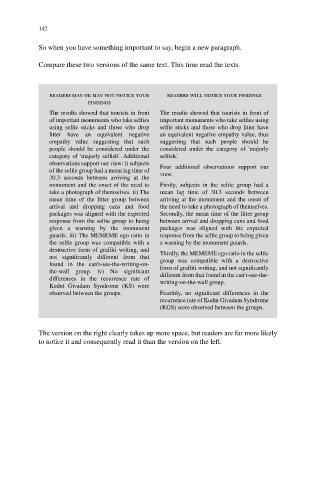
              Compare these two versions of the same text. This time read the texts.


                  readers may or may not notice your      readers will notice your findings
                         findings
                 The results showed that tourists in front    The results showed that tourists in front of
               of important monuments who take selfi es   important monuments who take selfi es using

               using selfie sticks and those who drop   selfie sticks and those who drop litter have

               litter have an equivalent negative   an equivalent negative empathy value, thus
               empathy value suggesting that such   suggesting that such people should be
               people should be considered under the   considered under the category of 'majorly
               category of 'majorly selfi sh'. Additional   selfi sh'.
               observations support our view: i) subjects     Four additional observations support our

               of the selfie group had a mean lag time of   view.
               30.3 seconds between arriving at the

               monument and the onset of the need to     Firstly, subjects in the selfie group had a
               take a photograph of themselves. ii) The   mean lag time of 30.3 seconds between
               mean time of the litter group between   arriving at the monument and the onset of
               arrival and dropping cans and food   the need to take a photograph of themselves.
               packages was aligned with the expected    Secondly, the mean time of the litter group

               response from the selfie group to being   between arrival and dropping cans and food
               given a warning by the monument   packages was aligned with the expected
               guards. iii) The MEMEME ego ratio in   response from the selfie group to being given

               the selfie group was compatible with a   a warning by the monument guards.


               destructive form of graffiti writing, and     Thirdly, the MEMEME ego ratio in the selfi e

               not significantly different from that   group was compatible with a destructive
               found in the can't-see-the-writing-on-  form of graffiti writing, and not signifi cantly

               the-wall group. iv) No signifi cant   different from that found in the can't-see-the-
               differences in the recurrence rate of   writing-on-the-wall group.
               Kudnt Givadam Syndrome (KS) were
               observed between the groups.    Fourthly, no significant differences in the

                                              recurrence rate of Kudnt Givadam Syndrome
                                              (KGS) were observed between the groups.
               The version on the right clearly takes up more space, but readers are far more likely
            to notice it and consequently read it than the version on the left.

