


Page 139 - Basic Japanese
P. 139
desu. Ja in negative forms is often  de wa in formal contexts. Do

                not confuse this with the word  arimasen all by itself; this is the
                negative of arimasu and means ‘there isn’t any.’

                     The  most  common  type  of  attention-focus  for  a  negative
                sentence in Japanese is on the negation itself ‘there ISN’T any
                bread.’ If you want to say ‘There isn’t any BREAD’ (that is, ‘It’s

                BREAD  that  we  lack  (rather  than  something  else)’),  then  you
                say Pan ga arimasen.

                     The polite perfect negative is a phrase, -masen deshita (for the
                copula  ja  arimasen  deshita),  and  similarly  the  polite  tentative

                negative is -nai deshō (for the copula ja nai deshō).


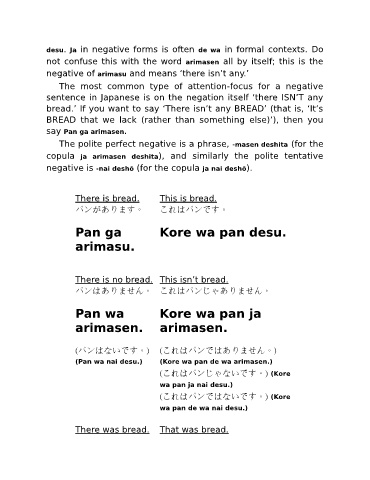
                          There is bread.             This is bread.
                          パンがあります。                    これはパンです。


                          Pan ga                      Kore wa pan desu.

                          arimasu.


                          There is no bread. This isn’t bread.
                          パンはありません。 これはパンじゃありません。


                          Pan wa                      Kore wa pan ja

                          arimasen.                   arimasen.


                          (パンはないです。)                  (これはパンではありません。)

                          (Pan wa nai desu.)          (Kore wa pan de wa arimasen.)
                                                      (これはパンじゃないです。) (Kore

                                                      wa pan ja nai desu.)
                                                      (これはパンではないです。) (Kore
                                                      wa pan de wa nai desu.)


                          There was bread.            That was bread.

