


Page 232 - Basic Japanese
P. 232
translated  in  English.  This  is  a  very  common  formula  in

                Japanese: it may be tacked on at the end of any sentence
                (with the verb, adjective, or copula in either plain imperfect

                or  plain  perfect),  giving  an  additional  refinement.  When  no
                desu is pronounced softly with a contraction, as in n desu, it

                somewhat  softens  the  directness  of  the  statement,  elicits
                the  listener’s  response  and  makes  the  dialog  more

                interactive.


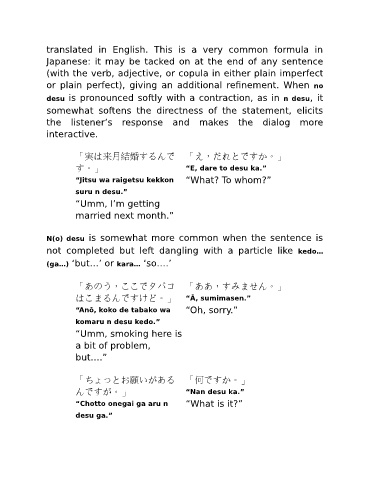
                          「実は来月結婚するんで                         「え,だれとですか。」

                          す。」                                 “E, dare to desu ka.”
                          “Jitsu wa raigetsu kekkon           “What? To whom?”

                          suru n desu.”
                          “Umm, I’m getting
                          married next month.”


                N(o) desu is somewhat more common when the sentence is

                not  completed  but  left  dangling  with  a  particle  like  kedo…
                (ga…) ‘but…’ or kara… ‘so….’


                          「あのう,ここでタバコ                         「ああ,すみません。」
                          はこまるんですけど。」                         “Ā, sumimasen.”

                          “Anō, koko de tabako wa             “Oh, sorry.”

                          komaru n desu kedo.”
                          “Umm, smoking here is
                          a bit of problem,

                          but….”


                          「ちょっとお願いがある                         「何ですか。」

                          んですが。」                              “Nan desu ka.”
                          “Chotto onegai ga aru n             “What is it?”

                          desu ga.”

