


Page 233 - Basic Japanese
P. 233
“I have a favor to ask,

                          but…”


                     If  uttered  with  a  firm  intonation,  with  or  without  the

                contraction,  no  desu  makes  the  expression  somewhat  more
                formal.


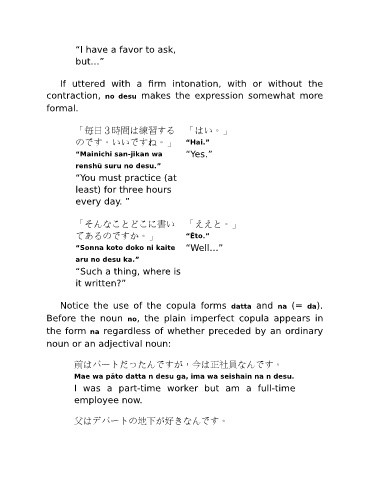
                          「毎日3時間は練習する                         「はい。」
                          のです。いいですね。」                         “Hai.”

                          “Mainichi san-jikan wa              “Yes.”
                          renshū suru no desu.”

                          “You must practice (at
                          least) for three hours
                          every day. ”


                          「そんなことどこに書い                         「ええと。」

                          てあるのですか。」                           “Ēto.”
                          “Sonna koto doko ni kaite           “Well…”

                          aru no desu ka.”
                          “Such a thing, where is
                          it written?”


                     Notice  the  use  of  the  copula  forms  datta  and  na  (=  da).
                Before  the  noun  no,  the  plain  imperfect  copula  appears  in

                the form na regardless of whether preceded by an ordinary

                noun or an adjectival noun:


                          前はパートだったんですが,今は正社員なんです。

                          Mae wa pāto datta n desu ga, ima wa seishain na n desu.
                          I  was  a  part-time  worker  but  am  a  full-time
                          employee now.


                          父はデパートの地下が好きなんです。

