


Page 397 - Basic Japanese
P. 397
Structure Notes


                8.1. Interrogatives +                          mo or             ka


                An  interrogative  is  a  word  that  asks  a  question,  like  dare

                ‘who,’  dore  ‘which,’  nani  ‘what,’  dō  ‘how,’  ikura  ‘how  much,’
                ikutsu ‘how many,’  itsu ‘when, what time,’  dono ‘which one,’

                or  donna  ‘what  sort  of.’  These  interrogatives  can  also  be

                followed by the particles mo and ka with special meanings.
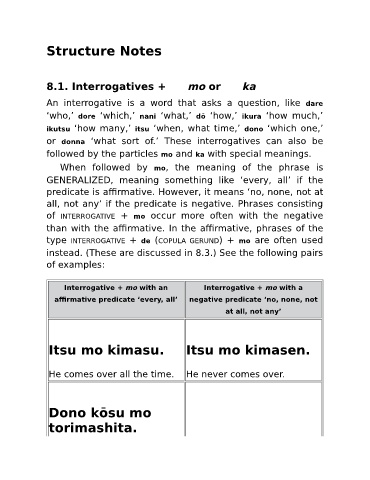
                     When  followed  by  mo,  the  meaning  of  the  phrase  is

                GENERALIZED,  meaning  something  like  ‘every,  all’  if  the
                predicate is affirmative. However, it means ‘no, none, not at

                all, not any’ if the predicate is negative. Phrases consisting
                of  INTERROGATIVE  +  mo  occur  more  often  with  the  negative

                than with the affirmative. In the affirmative, phrases of the
                type INTERROGATIVE +  de (COPULA  GERUND)  +  mo are  often used

                instead. (These are discussed in 8.3.) See the following pairs

                of examples:


                      Interrogative + mo with an                     Interrogative + mo with a

                   affirmative predicate ‘every, all’             negative predicate ‘no, none, not
                                                                            at all, not any’


                 Itsu mo kimasu.                               Itsu mo kimasen.


                 He comes over all the time.                   He never comes over.


                 Dono kōsu mo

                 torimashita.

