


Page 465 - Basic Japanese
P. 465
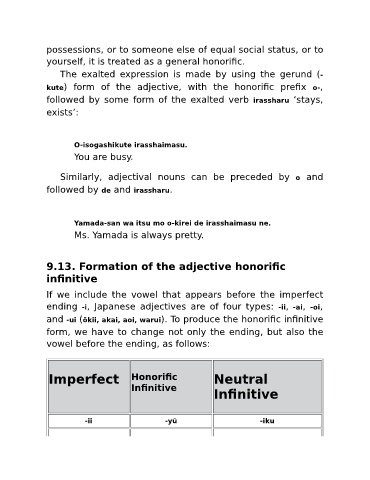
possessions, or to someone else of equal social status, or to

                yourself, it is treated as a general honorific.

                     The  exalted  expression  is  made  by  using  the  gerund  (-
                kute)  form  of  the  adjective,  with  the  honorific  prefix  o-,

                followed by some  form of the exalted verb  irassharu ‘stays,
                exists’:


                          O-isogashikute irasshaimasu.
                          You are busy.


                     Similarly,  adjectival  nouns  can  be  preceded  by  o  and

                followed by de and irassharu.


                          Yamada-san wa itsu mo o-kirei de irasshaimasu ne.
                          Ms. Yamada is always pretty.


                9.13. Formation of the adjective honorific
                infinitive


                If  we  include  the  vowel  that  appears  before  the  imperfect
                ending  -i,  Japanese  adjectives  are  of  four  types:  -ii,  -ai,  -oi,

                and -ui (ōkii, akai, aoi, warui). To produce the honorific infinitive
                form, we have to change not only the ending, but also the

                vowel before the ending, as follows:


                 Imperfect                  Honorific                    Neutral
                                            Infinitive
                                                                        Infinitive


                             -ii                        -yū                            -iku

