


Page 509 - Basic Japanese
P. 509
10.11. Double negatives


                In  English,  we  sometimes  hear  two  negative  words  in  a

                sentence where one would be enough, for example, ‘Nobody
                never  does  anything’  with  the  same  meaning  as  ‘Nobody

                ever  does  anything.’  In  Japanese  when  two  negatives  are
                used,  the  meaning  is  always  changed.  Notice  the

                translations of the following sentences.


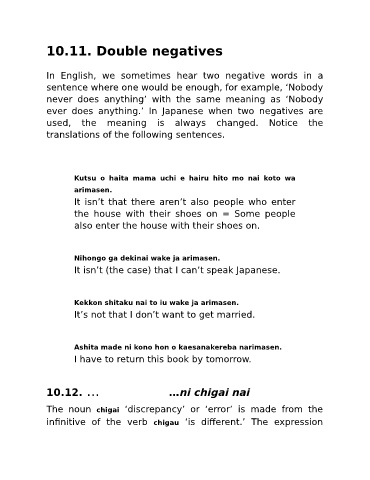
                          Kutsu  o  haita  mama  uchi  e  hairu  hito  mo  nai  koto  wa
                          arimasen.
                          It  isn’t  that  there  aren’t  also  people  who  enter

                          the  house  with  their  shoes  on  =  Some  people
                          also enter the house with their shoes on.


                          Nihongo ga dekinai wake ja arimasen.

                          It isn’t (the case) that I can’t speak Japanese.


                          Kekkon shitaku nai to iu wake ja arimasen.
                          It’s not that I don’t want to get married.


                          Ashita made ni kono hon o kaesanakereba narimasen.
                          I have to return this book by tomorrow.


                10.12. …                                 …ni chigai nai


                The  noun  chigai  ‘discrepancy’  or  ‘error’  is  made  from  the

                infinitive  of  the  verb  chigau  ‘is  different.’  The  expression

