


Page 90 - Basic Japanese
P. 90
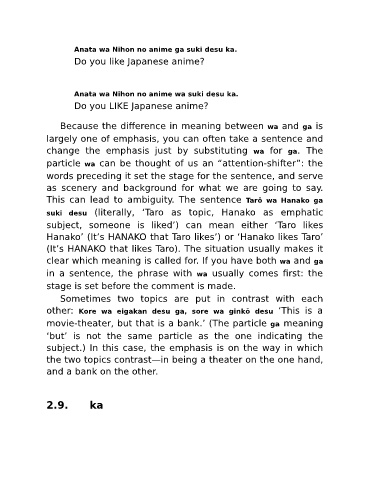
Anata wa Nihon no anime ga suki desu ka.

                          Do you like Japanese anime?


                          Anata wa Nihon no anime wa suki desu ka.
                          Do you LIKE Japanese anime?


                     Because the difference in meaning between wa and ga is

                largely one of emphasis, you can often take a sentence and
                change  the  emphasis  just  by  substituting  wa  for  ga.  The

                particle wa can be thought of us an “attention-shifter”: the
                words preceding it set the stage for the sentence, and serve

                as  scenery  and  background  for  what  we  are  going  to  say.
                This  can  lead  to  ambiguity.  The  sentence  Tarō  wa  Hanako  ga

                suki  desu  (literally,  ‘Taro  as  topic,  Hanako  as  emphatic
                subject,  someone  is  liked’)  can  mean  either  ‘Taro  likes

                Hanako’ (It’s HANAKO that Taro likes’) or ‘Hanako likes Taro’
                (It’s HANAKO that likes Taro). The situation usually makes it

                clear which meaning is called for. If you have both wa and ga
                in  a  sentence,  the  phrase  with  wa  usually  comes  first:  the

                stage is set before the comment is made.
                     Sometimes  two  topics  are  put  in  contrast  with  each

                other:  Kore  wa  eigakan  desu  ga,  sore  wa  ginkō  desu  ‘This  is  a

                movie-theater, but that is a bank.’ (The particle ga meaning
                ‘but’  is  not  the  same  particle  as  the  one  indicating  the

                subject.) In this case, the emphasis is on the way in which
                the two topics contrast—in being a theater on the one hand,

                and a bank on the other.


                2.9.          ka

