


Page 93 - Basic Japanese
P. 93
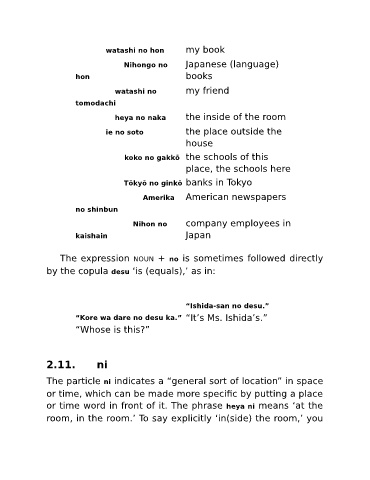
watashi no hon            my book

                                          Nihongo no          Japanese (language)
                          hon                                 books

                                       watashi no             my friend
                          tomodachi


                                       heya no naka           the inside of the room
                                    ie no soto                the place outside the
                                                              house

                                          koko no gakkō the schools of this

                                                              place, the schools here
                                          Tōkyō no ginkō banks in Tokyo


                                                Amerika       American newspapers
                          no shinbun

                                             Nihon no         company employees in

                          kaishain                            Japan


                     The expression NOUN + no is sometimes followed directly

                by the copula desu ‘is (equals),’ as in:


                                                              “Ishida-san no desu.”
                          “Kore wa dare no desu ka.” “It’s Ms. Ishida’s.”

                          “Whose is this?”


                2.11.            ni


                The particle ni indicates a “general sort of location” in space
                or time, which can be made more specific by putting a place
                or time word in front of it. The phrase heya ni means ‘at the

                room, in the room.’ To say explicitly ‘in(side) the room,’ you

