


Page 11 - Spok Inside Track
P. 11
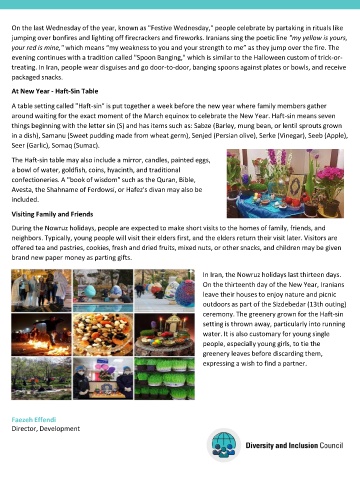
On the last Wednesday of the year, known as "Festive Wednesday," people celebrate by partaking in rituals like
     jumping over bonfires and lighting off firecrackers and fireworks. Iranians sing the poetic line "my yellow is yours,
     your red is mine," which means “my weakness to you and your strength to me” as they jump over the fire. The
     evening continues with a tradition called "Spoon Banging," which is similar to the Halloween custom of trick-or-
     treating. In Iran, people wear disguises and go door-to-door, banging spoons against plates or bowls, and receive
     packaged snacks.
     At New Year - Haft-Sin Table

     A table setting called "Haft-sin" is put together a week before the new year where family members gather
     around waiting for the exact moment of the March equinox to celebrate the New Year. Haft-sin means seven
     things beginning with the letter sin (S) and has items such as: Sabze (Barley, mung bean, or lentil sprouts grown
     in a dish), Samanu (Sweet pudding made from wheat germ), Senjed (Persian olive), Serke (Vinegar), Seeb (Apple),
     Seer (Garlic), Somaq (Sumac).
     The Haft-sin table may also include a mirror, candles, painted eggs,
     a bowl of water, goldfish, coins, hyacinth, and traditional
     confectioneries. A "book of wisdom" such as the Quran, Bible,
     Avesta, the Shahname of Ferdowsi, or Hafez's divan may also be
     included.

     Visiting Family and Friends
     During the Nowruz holidays, people are expected to make short visits to the homes of family, friends, and
     neighbors. Typically, young people will visit their elders first, and the elders return their visit later. Visitors are
     offered tea and pastries, cookies, fresh and dried fruits, mixed nuts, or other snacks, and children may be given
     brand new paper money as parting gifts.

                                                              In Iran, the Nowruz holidays last thirteen days.
                                                              On the thirteenth day of the New Year, Iranians
                                                              leave their houses to enjoy nature and picnic
                                                              outdoors as part of the Sizdebedar (13th outing)
                                                              ceremony. The greenery grown for the Haft-sin
                                                              setting is thrown away, particularly into running
                                                              water. It is also customary for young single
                                                              people, especially young girls, to tie the
                                                              greenery leaves before discarding them,
                                                              expressing a wish to find a partner.


     Faezeh Effendi
     Director, Development

