


Page 117 - Module DMV20173
P. 117
6.0    POLYMER PROCESSING

                      11. Cavity meant that the pressure in the mold could be monitored and used to control the

                         machine.
                      12. The means that mold filling speed and mold pressure can be controlled to give a better
                         quality  control  of  the  component  and  ensure  density  control  of  the  part  as  well  as

                         ensuring the component does not flash.
                      13. The use of microprocessors now  means  that once  the parameters  are known for the
                         production of a component the set up operation can be automatically adjusted when the
                         component is put on the machine again.


                  6.2.7 MOLDING CYCLE

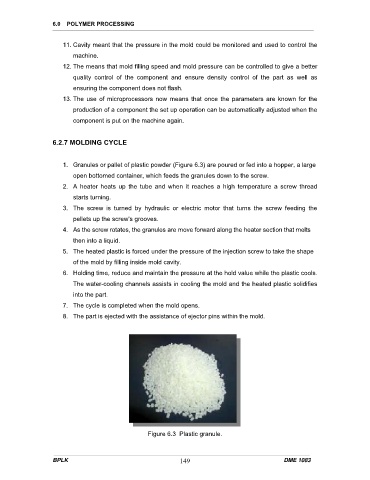
                      1.  Granules or pallet of plastic powder (Figure 6.3) are poured or fed into a hopper, a large

                         open bottomed container, which feeds the granules down to the screw.
                      2.  A  heater  heats  up  the  tube  and  when  it  reaches  a  high  temperature  a  screw  thread
                         starts turning.
                      3.  The  screw  is  turned  by  hydraulic  or  electric  motor  that  turns  the  screw  feeding  the
                         pellets up the screw's grooves.

                      4.  As the screw rotates, the granules are move forward along the heater section that melts
                         then into a liquid.
                      5.  The heated plastic is forced under the pressure of the injection screw to take the shape
                         of the mold by filling inside mold cavity.

                      6.  Holding time, reduce and maintain the pressure at the hold value while the plastic cools.
                         The water-cooling channels assists in cooling the mold and the heated plastic solidifies
                         into the part.
                      7.  The cycle is completed when the mold opens.
                      8.  The part is ejected with the assistance of ejector pins within the mold.


                                                  Figure 6.3  Plastic granule.


                  BPLK                                       149                                   DME 1083

