


Page 118 - Module DMV20173
P. 118
6.0    POLYMER PROCESSING

                  6.2.8 THE MOLD


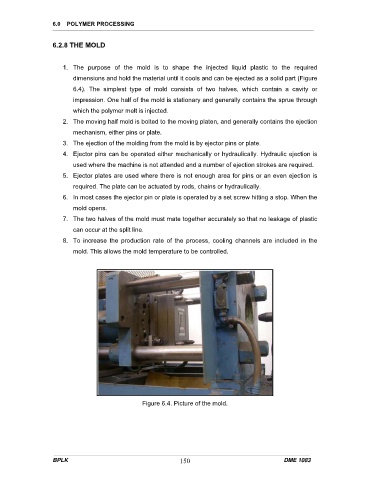
                      1.  The  purpose  of  the  mold  is  to  shape  the  injected  liquid  plastic  to  the  required
                         dimensions and hold the material until it cools and can be ejected as a solid part (Figure

                         6.4).  The  simplest  type  of  mold  consists  of  two  halves,  which  contain  a  cavity  or
                         impression. One half of the mold is stationary and generally contains the sprue through
                         which the polymer melt is injected.
                      2.  The moving half mold is bolted to the moving platen, and generally contains the ejection

                         mechanism, either pins or plate.
                      3.  The ejection of the molding from the mold is by ejector pins or plate.
                      4.  Ejector pins can be operated either mechanically or hydraulically. Hydraulic ejection is
                         used where the machine is not attended and a number of ejection strokes are required.

                      5.  Ejector plates are used where there is not enough area for pins or an even ejection is
                         required. The plate can be actuated by rods, chains or hydraulically.
                      6.  In most cases the ejector pin or plate is operated by a set screw hitting a stop. When the
                         mold opens.
                      7.  The two halves of the mold must mate together accurately so that no leakage of plastic

                         can occur at the split line.
                      8.  To  increase  the  production  rate  of  the  process,  cooling  channels  are  included  in  the
                         mold. This allows the mold temperature to be controlled.


                                                Figure 6.4. Picture of the mold.


                  BPLK                                       150                                   DME 1083

