


Page 128 - Module DMV20173
P. 128
6.0    POLYMER PROCESSING

                      13. The nip rolls, one rubber coated and the other polished steel, (stainless steel or chrome

                         plated) are pressed tight enough together not to allow air to escape from the inside of
                         the blown bubble.
                      14. The nip rolls are driven at a faster speed than the extrusion, producing biaxial strain on

                         the blown film.
                      15. This causes the film produced to be stronger in all directions.
                      16. The flat tube is then brought down over the nip rolls to be wound onto a drum.
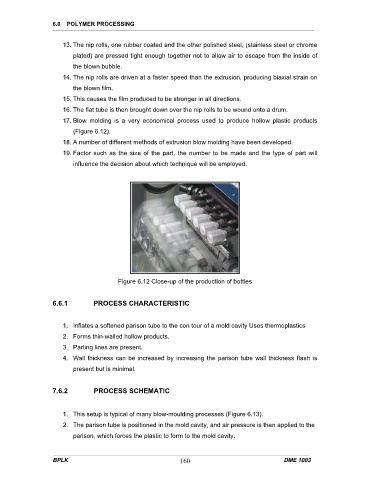
                      17. Blow  molding  is  a  very  economical  process  used  to  produce  hollow  plastic  products
                         (Figure 6.12).

                      18. A number of different methods of extrusion blow molding have been developed.
                      19. Factor such as the size of the part, the number to be made and the type of part will
                         influence the decision about which technique will be employed.


                                        Figure 6.12 Close-up of the production of bottles


                  6.6.1         PROCESS CHARACTERISTIC

                      1.  Inflates a softened parison tube to the con tour of a mold cavity Uses thermoplastics

                      2.  Forms thin-walled hollow products.
                      3.  Parting lines are present.
                      4.  Wall thickness can  be increased by increasing the parison tube wall thickness  flash  is
                         present but is minimal.


                  7.6.2         PROCESS SCHEMATIC


                      1.  This setup is typical of many blow-moulding processes (Figure 6.13).
                      2.  The parison tube is positioned in the mold cavity, and air pressure is then applied to the
                         parison, which forces the plastic to form to the mold cavity.


                  BPLK                                       160                                   DME 1083

