


Page 127 - Module DMV20173
P. 127
6.0    POLYMER PROCESSING

                  6.6 BLOW MOULDING


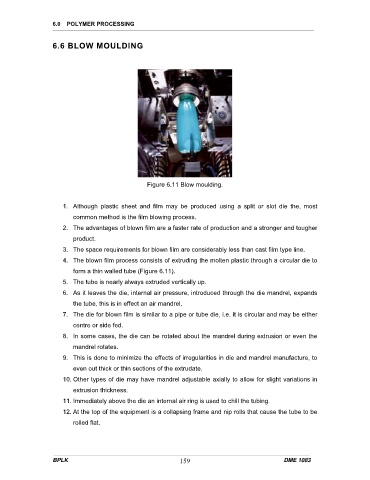
                                                  Figure 6.11 Blow moulding.


                      1.  Although  plastic  sheet  and  film  may  be  produced  using  a  split  or  slot  die  the,  most
                         common method is the film blowing process.
                      2.  The advantages of blown film are a faster rate of production and a stronger and tougher
                         product.

                      3.  The space requirements for blown film are considerably less than cast film type line.
                      4.  The blown film process consists of extruding the molten plastic through a circular die to
                         form a thin walled tube (Figure 6.11).
                      5.  The tube is nearly always extruded vertically up.

                      6.  As it leaves the die, internal air pressure, introduced through the die mandrel, expands
                         the tube, this is in effect an air mandrel.
                      7.  The die for blown film is similar to a pipe or tube die, i.e. it is circular and may be either
                         centre or side fed.

                      8.  In some cases, the die can be rotated about the mandrel during extrusion or even the
                         mandrel rotates.
                      9.  This is done to minimize the effects of irregularities in die and mandrel manufacture, to
                         even out thick or thin sections of the extrudate.

                      10. Other types of die may have mandrel adjustable axially to allow for slight variations in
                         extrusion thickness.
                      11. Immediately above the die an internal air ring is used to chill the tubing.
                      12. At the top of the equipment is a collapsing frame and nip rolls that cause the tube to be
                         rolled flat.


                  BPLK                                       159                                   DME 1083

