


Page 150 - Module DMV20173
P. 150
8.0   POWDER PROCESSING


                     9.2.2  BLENDING METAL POWDERS


                        1.  Blending refers to when the powders of the same chemical composition but possibly
                            different particle size are intermingled.
                        2.  Different particle are blended to reduce porosity.

                        3.  Mixing refers to powders of different chemistries being combined.
                        4.  An advantage of PM technology is the opportunity to mix various metals into alloys
                            that would be difficult or impossible to produce by other process.
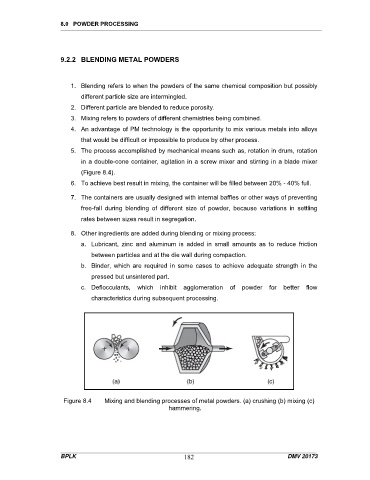
                        5.  The process accomplished by mechanical means such as, rotation in drum, rotation

                            in a double-cone container, agitation in a screw mixer and stirring in a blade mixer
                            (Figure 8.4).
                        6.  To achieve best result in mixing, the container will be filled between 20% - 40% full.

                        7.  The containers are usually designed with internal baffles or other ways of preventing
                            free-fall  during  blending  of  different  size  of  powder,  because  variations  in  settling
                            rates between sizes result in segregation.

                        8.  Other ingredients are added during blending or mixing process:

                            a.  Lubricant,  zinc  and  aluminum  is  added  in  small  amounts  as  to  reduce  friction
                               between particles and at the die wall during compaction.
                            b.  Binder,  which  are  required  in  some  cases  to  achieve  adequate  strength  in  the
                               pressed but unsintered part.
                            c.  Deflocculants,  which  inhibit  agglomeration  of  powder  for  better  flow

                               characteristics during subsequent processing.


                      Figure 8.4    Mixing and blending processes of metal powders. (a) crushing (b) mixing (c)
                                                         hammering.


                     BPLK                                       182                                   DMV 20173

