


Page 151 - Module DMV20173
P. 151
8.0   POWDER PROCESSING


                     9.2.3  SINTERING

                        1.  The last process is sintering, the process after pressing, the purpose of this process

                            in improve strength and hardness of green compact.
                        2.  This green compact is easily crumbled under low stress.
                        3.  Sintering is a hear treatment operation performed on the compact to bond its metallic
                            particles, thereby increasing strength and hardness.

                        4.  Since  powder  metallurgy  application  is  usually  involve  medium  to  high  production,
                            most sintering furnace are designed with mechanized flow-through capability for the
                            work part.
                        5.  The  process  of  heat  treatment  consists  of  three  steps  where  the  furnace  is
                            segregated into three chambers according to respective process:

                            a.  Preheat, in which the lubricants and binders are burned off.
                            b.  Sinter.
                            c.  Cool down.


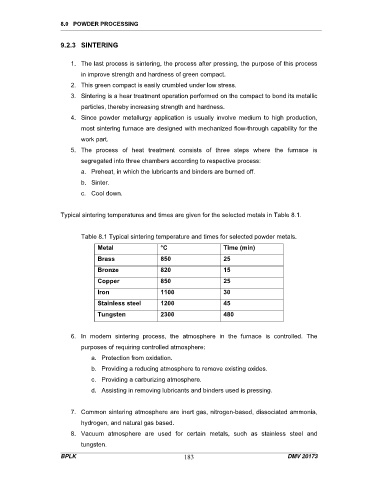
                     Typical sintering temperatures and times are given for the selected metals in Table 8.1.

                            Table 8.1 Typical sintering temperature and times for selected powder metals.
                                 Metal                °C                   Time (min)

                                 Brass                850                  25
                                 Bronze               820                  15
                                 Copper               850                  25

                                 Iron                 1100                 30
                                 Stainless steel      1200                 45
                                 Tungsten             2300                 480


                        6.  In  modern  sintering  process,  the  atmosphere  in  the  furnace  is  controlled.  The
                            purposes of requiring controlled atmosphere:
                               a.  Protection from oxidation.
                               b.  Providing a reducing atmosphere to remove existing oxides.

                               c.  Providing a carburizing atmosphere.
                               d.  Assisting in removing lubricants and binders used is pressing.

                        7.  Common sintering atmosphere are inert gas, nitrogen-based, dissociated ammonia,
                            hydrogen, and natural gas based.

                        8.  Vacuum  atmosphere  are  used  for  certain  metals,  such  as  stainless  steel  and
                            tungsten.

                     BPLK                                       183                                   DMV 20173

