


Page 211 - Python Data Science Handbook
P. 211
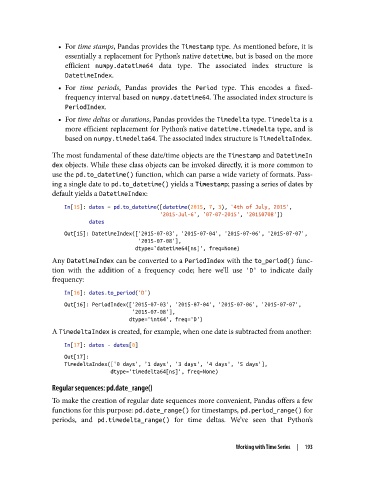
• For time stamps, Pandas provides the Timestamp type. As mentioned before, it is
                   essentially a replacement for Python’s native datetime, but is based on the more
                   efficient numpy.datetime64  data type. The associated index structure is
                   DatetimeIndex.
                 • For time periods, Pandas provides the Period  type. This encodes a fixed-
                   frequency interval based on numpy.datetime64. The associated index structure is
                   PeriodIndex.
                 • For time deltas or durations, Pandas provides the Timedelta type. Timedelta is a
                   more efficient replacement for Python’s native datetime.timedelta type, and is
                   based on numpy.timedelta64. The associated index structure is TimedeltaIndex.

               The most fundamental of these date/time objects are the Timestamp and DatetimeIn
               dex objects. While these class objects can be invoked directly, it is more common to
               use the pd.to_datetime() function, which can parse a wide variety of formats. Pass‐
               ing a single date to pd.to_datetime() yields a Timestamp; passing a series of dates by
               default yields a DatetimeIndex:

                   In[15]: dates = pd.to_datetime([datetime(2015, 7, 3), '4th of July, 2015',
                                                  '2015-Jul-6', '07-07-2015', '20150708'])
                           dates
                   Out[15]: DatetimeIndex(['2015-07-03', '2015-07-04', '2015-07-06', '2015-07-07',
                                           '2015-07-08'],
                                          dtype='datetime64[ns]', freq=None)
               Any DatetimeIndex can be converted to a PeriodIndex with the to_period() func‐
               tion with the addition of a frequency code; here we’ll use 'D'  to indicate daily
               frequency:

                   In[16]: dates.to_period('D')
                   Out[16]: PeriodIndex(['2015-07-03', '2015-07-04', '2015-07-06', '2015-07-07',
                                         '2015-07-08'],
                                        dtype='int64', freq='D')
               A TimedeltaIndex is created, for example, when one date is subtracted from another:

                   In[17]: dates - dates[0]
                   Out[17]:
                   TimedeltaIndex(['0 days', '1 days', '3 days', '4 days', '5 days'],
                                  dtype='timedelta64[ns]', freq=None)
               Regular sequences: pd.date_range()
               To make the creation of regular date sequences more convenient, Pandas offers a few
               functions for this purpose: pd.date_range() for timestamps, pd.period_range() for
               periods, and pd.timedelta_range()  for time deltas. We’ve seen that Python’s


                                                                  Working with Time Series  |  193

