


Page 530 - Python Data Science Handbook
P. 530
Out[15]: 33.0
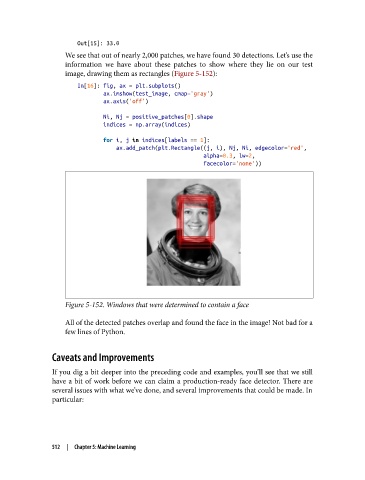
                   We see that out of nearly 2,000 patches, we have found 30 detections. Let’s use the
                   information we have about these patches to show where they lie on our test
                   image, drawing them as rectangles (Figure 5-152):
                      In[16]: fig, ax = plt.subplots()
                              ax.imshow(test_image, cmap='gray')
                              ax.axis('off')

                              Ni, Nj = positive_patches[0].shape
                              indices = np.array(indices)

                              for i, j in indices[labels == 1]:
                                  ax.add_patch(plt.Rectangle((j, i), Nj, Ni, edgecolor='red',
                                                             alpha=0.3, lw=2,
                                                             facecolor='none'))


                   Figure 5-152. Windows that were determined to contain a face

                   All of the detected patches overlap and found the face in the image! Not bad for a
                   few lines of Python.


               Caveats and Improvements

               If you dig a bit deeper into the preceding code and examples, you’ll see that we still
               have a bit of work before we can claim a production-ready face detector. There are
               several issues with what we’ve done, and several improvements that could be made. In
               particular:


               512  |  Chapter 5: Machine Learning

