


Page 527 - Python Data Science Handbook
P. 527
negative_patches = np.vstack([extract_patches(im, 1000, scale)
                                             for im in images for scale in [0.5, 1.0, 2.0]])
                      negative_patches.shape
                      Out[5]: (30000, 62, 47)
                   We now have 30,000 suitable image patches that do not contain faces. Let’s take a
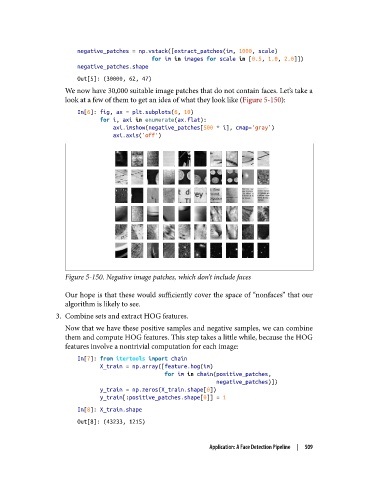
                   look at a few of them to get an idea of what they look like (Figure 5-150):

                      In[6]: fig, ax = plt.subplots(6, 10)
                             for i, axi in enumerate(ax.flat):
                                 axi.imshow(negative_patches[500 * i], cmap='gray')
                                 axi.axis('off')


                   Figure 5-150. Negative image patches, which don’t include faces

                   Our hope is that these would sufficiently cover the space of “nonfaces” that our
                   algorithm is likely to see.
                3. Combine sets and extract HOG features.
                   Now that we have these positive samples and negative samples, we can combine
                   them and compute HOG features. This step takes a little while, because the HOG
                   features involve a nontrivial computation for each image:
                      In[7]: from itertools import chain
                             X_train = np.array([feature.hog(im)
                                                 for im in chain(positive_patches,
                                                                 negative_patches)])
                             y_train = np.zeros(X_train.shape[0])
                             y_train[:positive_patches.shape[0]] = 1
                      In[8]: X_train.shape
                      Out[8]: (43233, 1215)


                                                           Application: A Face Detection Pipeline  |  509

