


Page 142 - Template Tesis UTM v2.0
P. 142
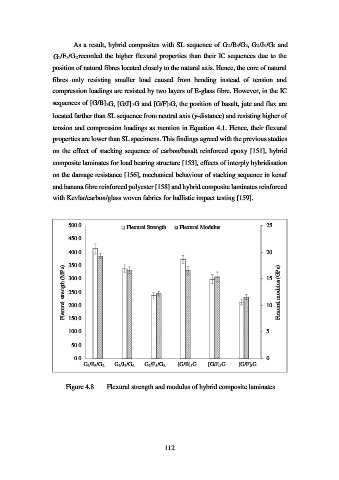
As a result, hybrid composites with SL sequence of G2/B3/G2, G2/J3/G2 and

                   G2/F3/G2 recorded the higher flexural properties than their IC sequences due to the
                   position of natural fibres located closely to the natural axis. Hence, the core of natural

                   fibres  only  resisting  smaller  load  caused  from  bending  instead  of  tension  and
                   compression loadings are resisted by two layers of E-glass fibre. However, in the IC

                   sequences of [G/B]3G, [G/J]3G and [G/F]3G, the position of basalt, jute and flax are
                   located farther than SL sequence from neutral axis (y-distance) and resisting higher of

                   tension and compression loadings as mention in Equation 4.1. Hence, their flexural

                   properties are lower than SL specimens. This findings agreed with the previous studies
                   on the effect of stacking sequence of carbon/basalt reinforced epoxy [151], hybrid

                   composite laminates for load bearing structure [153], effects of interply hybridisation
                   on the damage resistance [156], mechanical behaviour of stacking sequence in kenaf

                   and banana fibre reinforced polyester [158] and hybrid composite laminates reinforced
                   with Kevlar/carbon/glass woven fabrics for ballistic impact testing [159].


                         500.0               Flexural Strength  Flexural Modulus              25

                         450.0

                         400.0                                                                20

                         350.0
                       Flexural strength (MPa)  300.0                                         15   Flexural modulus (GPa)


                         250.0

                         200.0
                                                                                              10
                         150.0

                         100.0                                                                5

                          50.0

                           0.0                                                                0
                              G2/B3/G2           G2/J3/G2            G2/F3/G2             [G/B]3G        [G/J]3G         [G/F]3G


                        Figure 4.8      Flexural strength and modulus of hybrid composite laminates


                                                           112

