


Page 141 - Template Tesis UTM v2.0
P. 141
filaments during loading, which is very diffused in jute as well as due to the need for

                   alkaline treatment [157]. In this light, fibrillation appears  to be a limiting factor for
                   tensile performance, whereas it provides a larger bonding surface between fibre and

                   matrix and may improve the flexural properties [136].


                           As shown in Figure 4.8, the G2/B3/G2 with SL sequence shows 9.7 % higher of

                   flexural strength and 14.1 % higher flexural modulus compared to the IC sequence,

                   [G/B]3G. This pattern is similarly observed on the hybrid laminate of G2/J3/G2 and
                   G2/F3/G2. For instance, the G2/J3/G2 exhibits 11.6 % and 7.8 % higher flexural strength

                   and modulus compared to [G/J]3G, while G2/F3/G2 shows 10.5 % and 5.7 % higher of
                   flexural  strength  and  modulus  than  [G/F]3.  SL  sequence  of  hybrid  laminated

                   composites highly significant on flexural loadings and these can be explained due to
                   the behaviour of the hybrid specimens under the bending load, whereas upper and

                   lower sides are in tension and compression modes. Two layers of glass at extreme sides

                   of SL sequence enable the hybrid laminates to withstand higher on flexural loading
                   since the cores of natural fibre seem at neutral position, only withstand smaller load

                   caused from bending. This observation can be supported with the composite beam
                   theory as shown in Equation 4.1 with the moment of inertia can be determined using

                   Equation 4.2.


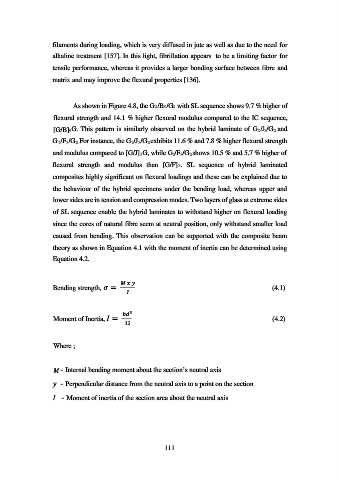
                   Bending strength,    =                                                          (4.1)


                                                 3
                   Moment of Inertia,    =                                                         (4.2)
                                            12


                   Where ;


                      - Internal bending moment about the section’s neutral axis

                       - Perpendicular distance from the neutral axis to a point on the section

                        - Moment of inertia of the section area about the neutral axis


                                                           111

