


Page 148 - Template Tesis UTM v2.0
P. 148
300          Specific Flexural Strength  Specific Flexural Modulus   14


                                                                                              12
                         250
                        Specific flexural strength (MPa.dm 3 /kg)  200                        8    Specific flexural modulus (GPa.dm 3 /kg)
                                                                                              10


                         150
                                                                                              6

                         100
                                                                                              4


                          50
                                                                                              2


                           0                                                                  0
                             G2/B3/G2           G2/J3/G2            G2/F3/G2             [G/B]3G        [G/J]3G         [G/F]3G


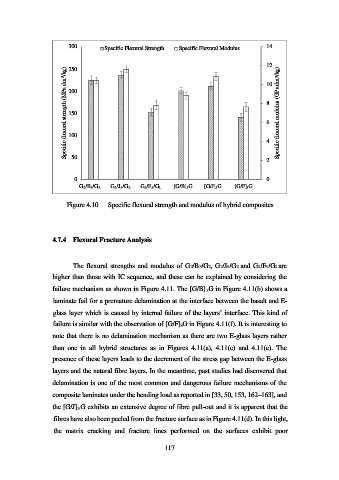
                        Figure 4.10    Specific flexural strength and modulus of hybrid composites


                   4.7.4  Flexural Fracture Analysis


                           The flexural  strengths  and modulus  of G2/B3/G2, G2/J3/G2 and G2/F3/G2 are

                   higher than those with IC sequence, and these can be explained by considering the


                   failure mechanism as shown in Figure 4.11. The [G/B]3G in Figure 4.11(b) shows a
                   laminate fail for a premature delamination at the interface between the basalt and E-

                   glass layer which is caused by internal failure of the layers’ interface. This kind of
                   failure is similar with the observation of [G/F]3G in Figure 4.11(f). It is interesting to

                   note that there is no delamination mechanism as there are two E-glass layers rather
                   than  one  in  all  hybrid  structures  as  in  Figures  4.11(a),  4.11(c)  and  4.11(e).  The

                   presence of these layers leads to the decrement of the stress gap between the E-glass

                   layers and the natural fibre layers. In the meantime, past studies had discovered that
                   delamination is one of the most common and dangerous failure mechanisms of the

                   composite laminates under the bending load as reported in [33, 50, 153, 162–163], and
                   the [G/J]3G exhibits an extensive degree of fibre pull-out and it is apparent that the

                   fibres have also been peeled from the fracture surface as in Figure 4.11(d). In this light,

                   the  matrix  cracking  and  fracture  lines  performed  on  the  surfaces  exhibit  poor

                                                           117

