


Page 152 - Template Tesis UTM v2.0
P. 152
4.8     Quasi-Static Indentation Property


                           The quasi-static indentation test was experimentally investigated on the hybrid

                   composites with SL and IC specimens of G2/B3/G2, G2/J3/G2, G2/F3/G2 and [G/B]3G,

                   [G/J]3G, [G/F]3G, respectively. In addition, pure composites were also investigated for
                   G7,  B7,  J7  and  F7.  Summary  of  quasi-static  indentation  properties  for  all  tested

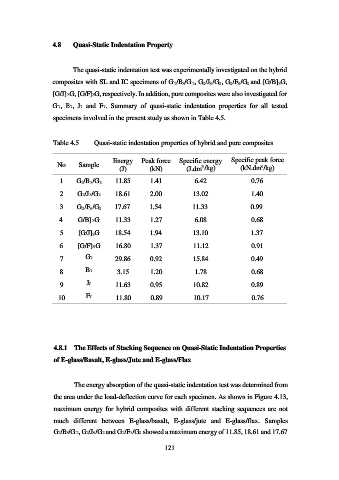
                   specimens involved in the present study as shown in Table 4.5.


                   Table 4.5      Quasi-static indentation properties of hybrid and pure composites


                                        Energy    Peak force    Specific energy   Specific peak force
                     No     Sample
                                                                                            3
                                                                        3
                                           (J)       (kN)         (J.dm /kg)         (kN.dm /kg)
                      1     G2/B3/G2     11.85       1.41            6.42                0.76

                      2     G2/J3/G2     18.61       2.00            13.02               1.40
                      3     G2/F3/G2     17.67       1.54            11.33               0.99

                      4     G/B]3G       11.33       1.27            6.08                0.68

                      5     [G/J]3G      18.54       1.94            13.10               1.37

                      6     [G/F]3G      16.80       1.37            11.12               0.91

                      7        G7        29.86       0.92            15.84               0.49

                      8        B7         3.15       1.20            1.78                0.68

                      9        J7        11.63       0.95            10.82               0.89

                     10        F7        11.80       0.89            10.17               0.76


                   4.8.1  The Effects of Stacking Sequence on Quasi-Static Indentation Properties

                   of E-glass/Basalt, E-glass/Jute and E-glass/Flax


                           The energy absorption of the quasi-static indentation test was determined from
                   the area under the load-deflection curve for each specimen. As shown in Figure 4.13,

                   maximum  energy  for  hybrid  composites  with  different  stacking  sequences  are  not
                   much  different  between  E-glass/basalt,  E-glass/jute  and  E-glass/flax.  Samples

                   G2/B3/G2, G2/J3/G2 and G2/F3/G2 showed a maximum energy of 11.85, 18.61 and 17.67

                                                           121

