


Page 37 - Template Tesis UTM v2.0
P. 37
2.2     Composite Materials


                           Composite materials normally consist of two or more constituents which can

                   be identified each of their elements after combining at macroscopic level. It consists

                   of reinforcing phase and matrix phase [16]. Composite materials cannot be defined
                   specifically because there are vast range of materials that used currently also can be

                   considered as a composite, and it is difficult to agree upon a single, simple and useful

                   definition. Typically, the development of modern composite materials with the intend
                   to achieve a balance of the material properties when it is in practices or during services.

                   Previous literature defined composite as a material which is created by combining two
                   or  more  dissimilar  reinforcements  to  achieve  a  better  property  than  its  parental

                   constituents [17]. The idea to develop a composite material is not just only to reinforce
                   fibres with continuous matrices such epoxy or polyester, but to produce an advanced

                   material with superior properties compared to its constituent material alone. In recent

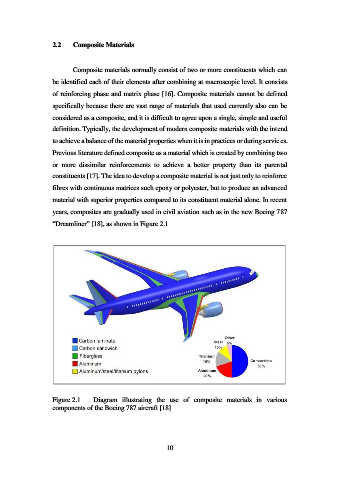
                   years, composites are gradually used in civil aviation such as in the new Boeing 787
                   “Dreamliner” [18], as shown in Figure 2.1


                   Figure 2.1     Diagram  illustrating  the  use  of  composite  materials  in  various
                   components of the Boeing 787 aircraft [18]


                                                           10

