


Page 39 - Template Tesis UTM v2.0
P. 39
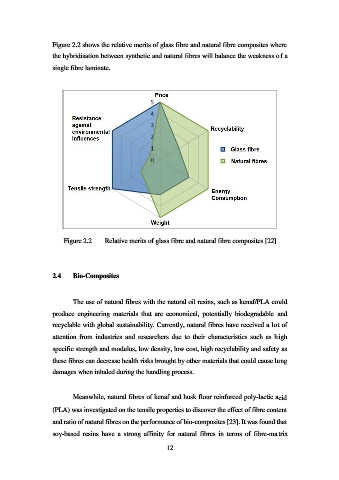
Figure 2.2 shows the relative merits of glass fibre and natural fibre composites where

                   the hybridisation between synthetic and natural fibres will balance the weakness of a
                   single fibre laminate.


                       Figure 2.2     Relative merits of glass fibre and natural fibre composites [22]


                   2.4     Bio-Composites


                           The use of natural fibres with the natural oil resins, such as kenaf/PLA could

                   produce  engineering  materials  that  are  economical,  potentially  biodegradable  and
                   recyclable with global sustainability. Currently, natural fibres have received a lot of

                   attention  from  industries  and  researchers  due  to  their  characteristics  such  as  high

                   specific strength and modulus, low density, low cost, high recyclability and safety as
                   these fibres can decrease health risks brought by other materials that could cause lung

                   damages when inhaled during the handling process.


                           Meanwhile, natural fibres of kenaf and husk flour reinforced poly-lactic acid

                   (PLA) was investigated on the tensile properties to discover the effect of fibre content

                   and ratio of natural fibres on the performance of bio-composites [23]. It was found that
                   soy-based  resins  have  a  strong  affinity  for  natural  fibres  in  terms  of  fibre-matrix

                                                           12

