


Page 45 - Spotlight A+ SPM Additional Mathematics Form 4 & 5
P. 45
Form
5
Chapter 8 Kinematics of Linear Motion Additional Mathematics
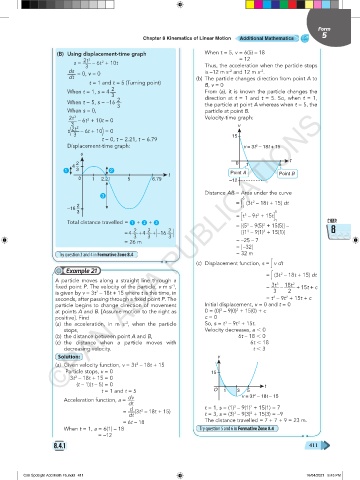
(B) Using displacement-time graph When t = 5, v = 6(5) – 18
= 12
s = 2t 3 – 6t + 10t Thus, the acceleration when the particle stops
2
3
ds = 0, v = 0 is –12 m s and 12 m s .
–2
–2
dt (b) The particle changes direction from point A to
t = 1 and t = 5 (Turning point) B, v = 0
2
When t = 1, s = 4 From (a), it is known the particle changes the
3 direction at t = 1 and t = 5. So, when t = 1,
When t = 5, s = –16 2 the particle at point A whereas when t = 5, the
3
When s = 0, particle at point B.
©PAN ASIA PUBLICATIONS
2t 3 – 6t + 10t = 0 Velocity-time graph:
2
3
t( 2t 2 – 6t + 10) = 0 v
3 15
t = 0, t = 2.21, t = 6.79
Displacement-time graph: v = 3t – 18t + 15
2
s
t
2 0 1 5
4 –
1 3 2
t Point A Point B
0 1 2.21 5 6.79 –12
Distance AB = Area under the curve
3 5
∫
= (3t – 18t + 15) dt
2
2 1
–16 –
3 5
[
= t – 9t + 15t ]
3
2
1
Total distance travelled = 1 + 2 + 3 = [(5 – 9(5) + 15(5)] – CHAP.
2
3
2
2
2
3
2
= 4 + 4 + –16 [(1 – 9(1) + 15(1)] 8
3 3 3
= 26 m = –25 – 7
= –32
Try question 3 and 4 in Formative Zone 8.4 = 32 m
∫
(c) Displacement function, s = v dt
Example 21
∫
= (3t – 18t + 15) dt
2
A particle moves along a straight line through a
fixed point P. The velocity of the particle, v m s , = 3t 3 – 18t 2 + 15t + c
–1
is given by v = 3t – 18t + 15 where t is the time, in 3 2
2
2
3
seconds, after passing through a fixed point P. The = t – 9t + 15t + c
particle begins to change direction of movement Initial displacement, v = 0 and t = 0
2
at points A and B. [Assume motion to the right as 0 = (0) – 9(0) + 15(0) + c
3
positive]. Find c = 0
2
3
–2
(a) the acceleration, in m s , when the particle So, s = t – 9t + 15t.
stops, Velocity decreases, a , 0
(b) the distance between point A and B, 6t – 18 , 0
(c) the distance when a particle moves with 6t , 18
decreasing velocity. t , 3
Solution: v
(a) Given velocity function, v = 3t – 18t + 15
2
Particle stops, v = 0 15
3t – 18t + 15 = 0
2
(t – 1)(t – 5) = 0 t
t = 1 and t = 5 O 1 3 5
2
Acceleration function, a = dv v = 3t – 18t – 15
dt 3 2
= d (3t – 18t + 15) t = 1, s = (1) – 9(1) + 15(1) = 7
2
3
2
dt t = 3, s = (3) – 9(3) + 15(3) = –9
= 6t – 18 The distance travelled = 7 + 7 + 9 = 23 m.
When t = 1, a = 6(1) – 18 Try question 5 and 6 in Formative Zone 8.4
= –12
8.4.1 411
C08 Spotlight Add Math F5.indd 411 16/04/2021 5:43 PM

