


Page 8 - Spotlight A+ Physics Form 4.5
P. 8
Form
           4         Physics   Chapter 3 Gravitation


              3.1    Newton's Universal Law of                  Object 1                   Object 2
                     Gravitation                                  m 1     F          F       m 2


                                                                                r

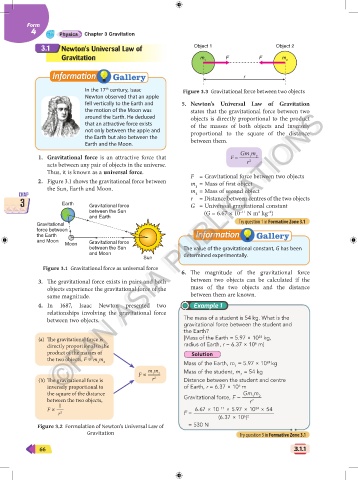
                             In the 17  century, Isaac       Figure 3.3  Gravitational force between two objects
                                   th
                             Newton observed that an apple
                             fell vertically to the Earth and     5.  Newton’s Universal Law of Gravitation
                             the motion of the Moon was        states that the gravitational force between two
                     ©PAN ASIA PUBLICATIONS
                    ©PAN ASIA PUBLICATIONS
                             around the Earth. He deduced      objects is directly proportional to the product
                             that an attractive force exists   of the masses of both objects and inversely
                             not only between the apple and    proportional  to  the  square  of  the  distance
                             the Earth but also between the
                             Earth and the Moon.               between them.
                                                                               Gm m
              1.  Gravitational force is an attractive force that           F =   1 2  2
                acts between any pair of objects in the universe.                r
                Thus, it is known as a universal force.        F  = Gravitational force between two objects
              2.  Figure 3.1 shows the gravitational force between   m  = Mass of first object
                                                                 1
                the Sun, Earth and Moon.                       m  = Mass of second object
       CHAP                                                    r  = Distance between centres of the two objects
                                                                 2
        3            Earth    Gravitational force              G  = Universsal gravitational constant
                              between the Sun                        (G = 6.67 × 10  N m  kg )
                                                                                        –2
                                                                               –11
                                                                                     2
                              and Earth
                                                                               Try question 1 in Formative Zone 3.1
             Gravitational
             force between
             the Earth
             and Moon         Gravitational force
                      Moon
                              between the Sun                The value of the gravitational constant, G has been
                              and Moon                       determined experimentally.
                                                Sun
               Figure 3.1  Gravitational force as universal force
                                                             6.  The magnitude of the gravitational force
              3.  The gravitational force exists in pairs and both   between  two objects  can be  calculated  if  the
                objects experience the gravitational force of the   mass  of the two  objects and  the distance
                same magnitude.                                between them are known.
              4.  In 1687, Isaac Newton presented two           Example 1
                relationships involving the gravitational force
                between two objects.                         The mass of a student is 54 kg. What is the
                                                             gravitational force between the student and
                                                             the Earth?
                                                                                     24
              (a)  The gravitational force is                [Mass of the Earth = 5.97 × 10  kg,
                                                                                    6
                directly proportional to the                 radius of Earth, r = 6.37 × 10  m]
                product of the masses of                       Solution
                the two objects, F ∝ m m
                                                                                        24
                                 1  2                        Mass of the Earth, m  = 5.97 × 10 kg
                                                                             1
                                                 m m         Mass of the student, m  = 54 kg
                                              F ∝   1  2                       2
              (b)  The gravitational force is     r 2        Distance between the student and centre
                                                                               6
                inversely proportional to                    of Earth, r = 6.37 × 10  m
                the square of the distance                                      Gm m 2
                                                                                   1
                between the two objects,                     Gravitational force, F =   r 2
                    1
                                                                                    24
                                                                        −11
                F ∝                                             6.67 × 10  × 5.97 × 10  × 54
                    r 2                                      F =
                                                                                6 2
                                                                        (6.37 × 10 )
             Figure 3.2  Formulation of Newton’s Universal Law of      = 530 N
                             Gravitation                                       Try question 3 in Formative Zone 3.1
              66                                                                                 3.1.1

