


Page 13 - Spotlight A+ Physics Form 4.5
P. 13
Form
           4         Physics   Chapter 4 Heat


              Conclusion:
              The smaller the volume of a gas, the higher the pressure of the gas. The hypothesis is accepted.
              Discussion:
                1.  A syringe with a large volume is used to obtain a higher change of volume and pressure of the air
                  trapped in it.
                2.  The piston is pushed slowly into the syringe so that the temperature of the air in the syringe is kept
                  constant.

                     ©PAN ASIA PUBLICATIONS
                                                             4.  The rate of collision between the molecules and
                                                               the wall of the container increases.

              Robert Boyle (1627-1691) was a scientist who     5.  The force per unit area on the surface of the
              emphasized on the scientific method when         wall increases. Thus, the gas pressure increases.
              conducting investigations. From experimental data,
              he made the conclusion that the volume of a gas is
              inversely proportional to the pressure of the gas.
                                                             For Boyle's law, temperature is constant.
              1.  Boyle’s law states that pressure is inversely         P    ×  V     Constant
                proportional to the volume of a fixed mass of
                gas at constant temperature.
                                                                            T
                                   1
                               P ∝
                                   V
                                   1
                              P = k 1 2                      PV = constant
                                                             P V  = P V
                                   V
                                                              1 1
                                                                   2 2
                where k is a constant
                    ©PAN ASIA PUBLICATIONS
                      P = pressure of the gas (Pa)
                                          3
                      V = volume of the gas (m )
       CHAP                                                  Eduweb TV: Boyle's law
        4       Therefore, PV = k                            http://bit.ly/2tb1y2I
                                Try question 1 in Formative Zone 4.4
              2.  Suppose a gas experiences a change of pressure
                and volume from an initial state to a final state.  Example 6
                Initial state of the gas, P V  = k
                                    1 1
                Final state of the gas, P V  = k             The air in a closed syringe has a volume of
                                   2 2
                                                             60 cm  and pressure 108 kPa. The piston of
                                                                  3
                Therefore,   P V  = P V                      the syringe was pushed to compress the air to
                            1 1   2 2
                                                             a volume of 48 cm . Find the pressure of the
                                                                            3
                                                             compressed air.
                                                               Solution
                             Volume is                       P = 108 kPa, P  = pressure of compressed air
                                                              1
                                                                         2
                             decreased                       V  = 60 cm    V  = 48 cm 3
                                                                      3
                                                              1          2
                                                             The temperature of gas is constant,
                                                             Boyle’s law is used:
                                                                P V  = P V
                                                                 1  1  2  2
                                                             108 × 60 = P  × 48
                Figure 4.27  A fixed mass of gas compressed at         2
                         constant temperature                     P  =   108 × 60
                                                                   2     48
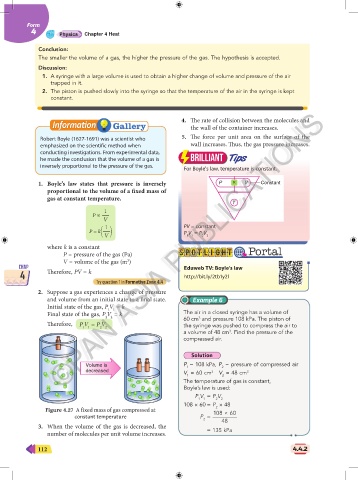
              3.  When the volume of the gas is decreased, the
                number of molecules per unit volume increases.       = 135 kPa
             112                                                                                4.4.2

