


Page 4 - 1202 Question Bank Chemistry Form 5 KSSM
P. 4
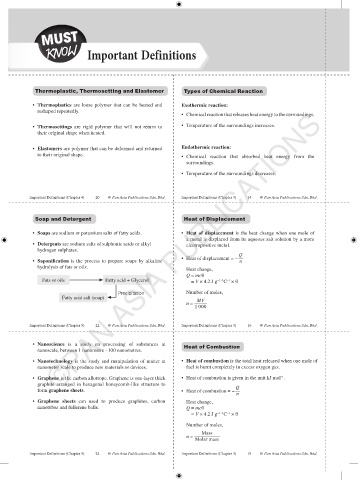
KNOW          Important Definitions


             Thermoplastic, Thermosetting and Elastomer           Types of Chemical Reaction


             •  Thermoplastics are loose polymer that can be heated and   Exothermic reaction:
              reshaped repeatedly.
                      ©PAN ASIA PUBLICATIONS
                                                                 •  Chemical reaction that releases heat energy to the surroundings.
             •  Thermosettings  are  rigid  polymer  that  will  not  return  to   •  Temperature of the surroundings increases.
              their original shape when heated.

             •  Elastomers are polymer that can be deformed and returned   Endothermic reaction:
              to their original shape.                           •  Chemical reaction that absorbed heat energy from the
                                                                   surroundings.
                                                                 •  Temperature of the surroundings decreases.


           Important Definitions (Chapter 4)   20   @ Pan Asia Publications Sdn. Bhd.  Important Definitions (Chapter 3)   14   @ Pan Asia Publications Sdn. Bhd.


             Soap and Detergent                                   Heat of Displacement

             •  Soaps are sodium or potassium salts of fatty acids.  •  Heat of displacement is the heat change when one mole of
                                                                   a metal is displaced from its aqueous salt solution by a more
             •  Detergents are sodium salts of sulphonic acids or alkyl   electropositive metal.
              hydrogen sulphates.
                                                                                      Q
                                                                 •  Heat of displacement = −
             •  Saponification is the process to prepare soaps by alkaline            n
              hydrolysis of fats or oils.
                                                                   Heat change,
                                                                   Q  = mcθ
                Fats or oils          Fatty acid + Glycerol          = V × 4.2 J g  °C  × θ
                                                                              −1
                                                                                 −1
                                           Precipitation           Number of moles,
                       Fatty acid salt (soap)                          MV
                                                                   n =
                                                                      1 000


           Important Definitions (Chapter 5)   22   @ Pan Asia Publications Sdn. Bhd.  Important Definitions (Chapter 3)   16   @ Pan Asia Publications Sdn. Bhd.


             •  Nanoscience is a study on processing of substances at   Heat of Combustion
              nanoscale, between 1 nanometre - 100 nanometres.

             •  Nanotechnology is the study and manipulation of matter at   •  Heat of combustion is the total heat released when one mole of
              nanometer scale to produce new materials or devices.  fuel is burnt completely in excess oxygen gas.
                                                                                                    −1
             •  Graphene is the carbon allotrope. Graphene is one-layer thick   •  Heat of combustion is given in the unit kJ mol .
              graphite arranged in hexagonal honeycomb-like structure to
                                                                                     Q
              form graphene sheets.                              •  Heat of combustion = −
                                                                                     n
             •  Graphene  sheets can used to produce graphites, carbon   Heat change,
              nanotubes and fullerene balls.                       Q  = mcθ
                                                                              −1
                                                                                 −1
                                                                     = V × 4.2 J g  °C  × θ
                                                                   Number of moles,
                                                                        Mass
                                                                   n =
                                                                      Molar mass

           Important Definitions (Chapter 5)   24   @ Pan Asia Publications Sdn. Bhd.  Important Definitions (Chapter 3)   18   @ Pan Asia Publications Sdn. Bhd.

