


Page 21 - 1202 Question Bank Chemistry Form 4 KSSM
P. 21
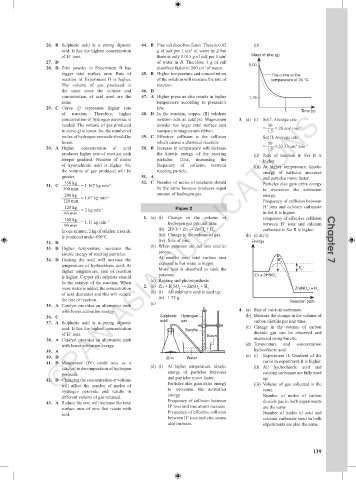
26.  B  Sulphuric acid is a strong diprotic    44.  B  Fine salt dissolves faster. There is 0.02   (ii)
                       acid. It has the highest concentration   g of salt per 1 cm  of water in A but
                                                                    3
                       of H  ions.                      there is only 0.015 g of salt per 1 cm   3  Mass of zinc (g)
                         +
                  27.  D                                of  water  in  B.  Therefore  3  g  of  salt
                  28.  D  Zinc powder in Experiment  II has   dissolves faster in 200 cm  of water.  5.00
                                                                         3
                       bigger total surface area. Rate of    45.  B  Higher temperature and concentration   The curve at the
                       reaction  of Experiment  II is higher.   of the solution will increase the rate of   temperature of 30 °C
                       The volume of gas produced is    reaction.
                       the  same  since  the volume  and    46.  D
                       concentration  of acid used are the    47.  A  Higher pressure also results in higher   1.75
                       same.                            temperature  according  to  pressure’s
                  29.  C  Curve  Q represents higher rate   law.
                       of  reaction.  Therefore,  higher   48.  D  In the reaction,  copper (II) sulphate   t 1  Time (s)
                      ©PAN ASIA PUBLICATIONS
                       concentration of hydrogen peroxide is   solution acts as catalyst. Magnesium     3.  (a)  (i)  Set I: Average rate
                       needed. The volume of gas produced   powder has larger total surface area   30  3  –1
                       in curve Q is lesser. So, the number of   compare to magnesium ribbon.  =  1.5  = 20 cm  min
                       moles of hydrogen peroxide should be    49.  C  Effective collision is the collision         Set II: Average rate
                       lesser.                          which causes a chemical reaction.      50
                                                                                                        3
                  30.  A  Higher  concentration  of  acid   50.  B  Increase in temperature will increase   =  1.5  = 33.33 cm  min –1
                       produces higher rate of reaction with   the kinetic energy of the reacting      (ii)  Rate of reaction  in Set II is
                       steeper gradient.  Number of moles   particles.  Thus,  increasing  the  higher
                       of hydrochloric  acid is higher. So,   frequency  of collision  between      (iii)  At higher temperature,  kinetic
                       the  volume  of gas produced  will  be   reacting particle.           energy of particles  increases
                       greater.                    51.  A                                    and particles move faster.
                        350 kg                     52.  C  Number of moles of reactants should         Particles also gain extra energy
                  31.  C      = 1.167 kg min –1
                       300 min                          be the same because produces equal   to overcome the activation
                        200 kg   = 1.67 kg min –1       amount of hydrogen gas.              energy.
                       120 min                                                               Frequency of collision between
                                                                                              +
                        120 kg   = 2 kg min –1                Paper 2                        H  ions and calcium carbonate
                        60 min                                                               in Set II is higher.
                        100 kg   = 1.11 kg min –1    1.  (a)  (i)  Change  in  the  volume  of         Frequency of effective collision
                                                                                                    +
                        90 min                              hydrogen gas per unit time.      between  H  ions and calcium
                        In one minute, 2 kg of sulphur trioxide      (ii)  2HCl + Zn → ZnCl  + H 2  carbonate in Set II is higher.
                                                                        2
                       is produced under 450ºC.          (iii)  Change in the volume of gas.  (b)  (i) & (ii)
                  32.  D                                 (iv)  Size of zinc              Energy                     Chapter 7
                  33.  D  Higher  temperature  increases  the   (b)  When  potatoes  are  cut  into  smaller
                       kinetic energy of reacting particles.  pieces.
                  34.  D  Heating  the acid  will increase the      At smaller  size,  total  surface  area   E a
                       temperature  of hydrochloric  acid. At   exposed to hot water is bigger.          E '
                       higher temperature,  rate of reaction      More heat is absorbed  to cook the      a
                       is higher. Copper (II) sulphate should   potatoes.                 Zn + 2HNO 3
                       be the catalyst of the reaction. When   (c)  Rusting and photosynthesis
                       more water is added, the concentration     2.  (a)  Zn + H SO  → ZnSO  + H 2     Zn(NO ) + H 2
                                                             2
                                                                      4
                                                                4
                                                                                                            3
                       of acid decreases and this will reduce   (b)  (i)  All sulphuric acid is used up.
                       the rate of reaction.             (ii)  1.75 g                                 Reaction path
                  35.  A  Catalyst provides an alternative path   (c)
                       with lower activation energy.                                  4.  (a)  Size of calcium carbonate.
                  36.  C                                 Sulphuric  Hydrogen           (b)  Measure the change in the volume of
                  37.  A  Sulphuric acid is a strong diprotic   acid  gas                 carbon dioxide per unit time.
                       acid. It has the highest concentration     Burette              (c)  Change  in  the  volume  of  carbon
                         +
                       of H  ions.                                       Basin            dioxide gas can be observed and
                  38.  A  Catalyst provides an alternative path                           measured using burette.
                       with lower activation energy.                                   (d)  Temperature  and  concentration
                  39.  A                                                                  hydrochloric acid.
                  40.  D                                   Zinc   Water                (e)  (i)  Experiment  II. Gradient  of the
                  41.  D  Manganese (IV)  oxide acts as a                                    curve in experiment II is higher.
                       catalyst in decomposition of hydrogen   (d)  (i)  At higher temperature,  kinetic      (ii)  All  hydrochloric  acid  and
                       peroxide.                            energy of particles  increases   calcium carbonate are fully used
                  42.  D  Changing the concentration or volume   and particles move faster.  up.
                       will  affect the number  of moles  of         Particles also gain extra energy      (iii)  Volume  of gas collected  is the
                       hydrogen peroxide and results in     to overcome the activation       same.
                       different volume of gas released.    energy.                          Number  of  moles  of  carbon
                  43.  A  Reduce the size will increase the total         Frequency of collision between   dioxide gas in both experiments
                                                             +
                       surface area of zinc that reacts with   H  ions and zinc atoms increase.  are the same
                       acid.                                Frequency of effective collision         Number of moles  of acid and
                                                                   +
                                                            between H  ions and zinc atoms   calcium carbonate used in both
                                                            also increase.                   experiments are also the same.


                                                                                                               139

