


Page 17 - 1202 Question Bank Chemistry Form 4 KSSM
P. 17
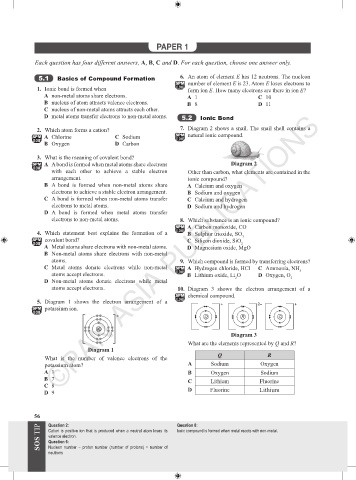
PAPER 1

             Each question has four different answers, A, B, C and D. For each question, choose one answer only.

               5.1   Basics of Compound Formation                6.  An atom of element E has 12 neutrons. The nucleon
                                                              SPM
                                                              SPM  number of element E is 23. Atom E loses electrons to
               1.  Ionic bond is formed when                   CLONE  form ion E. How many electrons are there in ion E?
                A  non-metal atoms share electrons.                A  1                    C  10
                B  nucleus of atom attracts valence electrons.     B  8                    D  11
                C  nucleus of non-metal atoms attracts each other.
                D  metal atoms transfer electrons to non-metal atoms.  5.2   Ionic Bond
                      ©PAN ASIA PUBLICATIONS

               2.  Which atom forms a cation?                    7.  Diagram 2 shows a snail. The snail shell contains a
                                                              SPM
            SPM  A  Chlorine             C  Sodium            SPM  natural ionic compound.
            SPM
             CLONE                                             CLONE
                B  Oxygen                D  Carbon
               3.  What is the meaning of covalent bond?
            SPM  A  A bond is formed when metal atoms share electrons             Diagram 2
            SPM
             CLONE
                   with each other to achieve  a stable electron      Other than carbon, what elements are contained in the
                   arrangement.                                    ionic compound?
                B  A bond is formed when non-metal  atoms share    A  Calcium and oxygen
                   electrons to achieve a stable electron arrangement.  B  Sodium and oxygen
                C  A bond is formed when non-metal atoms transfer   C  Calcium and hydrogen
                   electrons to metal atoms.                       D  Sodium and hydrogen
                D  A bond is formed when metal  atoms transfer
                   electrons to non-metal atoms.                 8.  Which substance is an ionic compound?
                                                              SPM  A  Carbon monoxide, CO
                                                              SPM
               4.  Which  statement  best explains the formation  of a   CLONE  B  Sulphur trioxide, SO
            SPM  covalent bond?                                    C  Silicon dioxide, SiO  3
            SPM
             CLONE                                                                   2
                A  Metal atoms share electrons with non-metal atoms.  D  Magnesium oxide, MgO
                B  Non-metal  atoms share electrons  with non-metal
                   atoms.                                        9.  Which compound is formed by transferring electrons?
                C  Metal  atoms  donate  electrons  while non-metal   SPM  A  Hydrogen chloride, HCl   C  Ammonia, NH
                                                              SPM
                   atoms accept electrons.                     CLONE  B  Lithium oxide, Li O   D  Oxygen, O  3
                D  Non-metal  atoms  donate  electrons  while  metal               2                   2
                   atoms accept electrons.                       10.  Diagram 3 shows  the electron arrangement  of a
                                                              SPM  chemical compound.
                                                              SPM
               5.  Diagram 1 shows  the electron arrangement  of a   CLONE    +            2–           +
            SPM
            SPM  potassium ion.
             CLONE
                                          +                              Q           R            Q
                                   K
                                                                                  Diagram 3
                                                                  What are the elements represented by Q and R?
                                Diagram 1
                What  is the number  of valence  electrons  of the           Q                 R
                 potassium atom?                                   A       Sodium           Oxygen
                A  1                                               B       Oxygen           Sodium
                B  7                                               C       Lithium          Fluorine
                C  8
                D  9                                               D       Fluorine         Lithium


             56   Question 2:                                  Question 8:
               SOS TIP  Cation is positive ion that is produced when a neutral atom loses its   Ionic compound is formed when metal reacts with non-metal.
                  valence electron.
                  Question 6:
             56   Nucleon  number – proton number (number of protons) = number of
                  neutrons

