


Page 19 - 1202 Question Bank Chemistry Form 4 KSSM
P. 19
PAPER 3


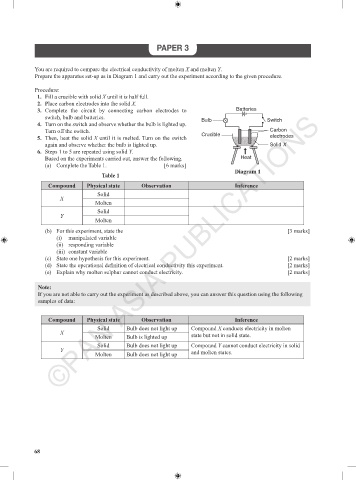
             You are required to compare the electrical conductivity of molten X and molten Y.
             Prepare the apparatus set-up as in Diagram 1 and carry out the experiment according to the given procedure.

             Procedure:
               1.  Fill a crucible with solid X until it is half full.
               2.  Place carbon electrodes into the solid X.
               3.  Complete  the circuit  by connecting  carbon electrodes  to      Batteries
                      ©PAN ASIA PUBLICATIONS
                 switch, bulb and batteries.
               4.  Turn on the switch and observe whether the bulb is lighted up.   Bulb      Switch
                 Turn off the switch.                                                          Carbon
               5.  Then, heat the solid X until it is melted. Turn on the switch   Crucible    electrodes
                 again and observe whether the bulb is lighted up.                             Solid X
               6.  Steps 1 to 5 are repeated using solid Y.
                Based on the experiments carried out, answer the following.          Heat
                (a)  Complete the Table 1.                [6 marks]
                                                                                   Diagram 1
                                     Table 1
                  Compound     Physical state      Observation                     Inference
                                   Solid
                      X
                                  Molten
                                   Solid
                      Y
                                  Molten

                (b)  For this experiment, state the                                                   [3 marks]
                     (i)  manipulated variable
                     (ii)  responding variable
                     (iii)  constant variable
                (c)  State one hypothesis for this experiment.                                        [2 marks]
                (d)  State the operational definition of electrical conductivity this experiment.     [2 marks]
                (e)  Explain why molten sulphur cannot conduct electricity.                           [2 marks]

              Note:
              If you are not able to carry out the experiment as described above, you can answer this question using the following
              samples of data:


                  Compound     Physical state      Observation                     Inference
                                   Solid     Bulb does not light up  Compound X conducts electricity in molten
                      X
                                  Molten     Bulb is lighted up     state but not in solid state.
                                   Solid     Bulb does not light up  Compound Y cannot conduct electricity in solid
                      Y                                             and molten states.
                                  Molten     Bulb does not light up


             68

