


Page 16 - 1202 Question Bank Chemistry Form 4 KSSM
P. 16
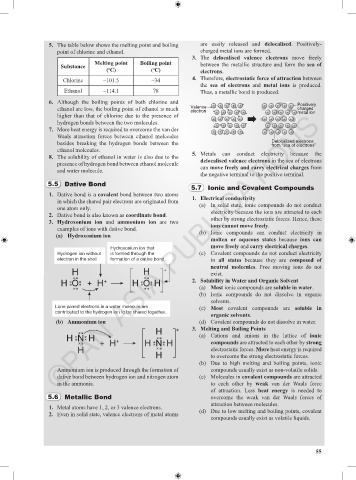
5.  The table below shows the melting point and boiling   are easily released and  delocalised. Positively-
                     point of chlorine and ethanol.                    charged metal ions are formed.
                                                                     3.  The  delocalised  valence  electrons move  freely
                                  Melting point   Boiling point
                      Substance                                        between the metallic structure and form the sea of
                                      ( C)            ( C)             electrons.
                                                       o
                                       o
                       Chlorine      –101.5           –34            4.  Therefore, electrostatic force of attraction between
                                                                       the  sea of electrons and  metal  ions is produced.
                       Ethanol       –114.1            78              Thus, a metallic bond is produced.
                   6.  Although the boiling points of both chlorine and                                  Positively
                     ethanol are low, the boiling point of ethanol is much   Valence  +  +  +  +  +  +  +  +  +  +  charged
                                                                    electron
                     higher than that of chlorine due to the presence of    +  +  +  +  +     +  +  +  +  + metal ion
                      ©PAN ASIA PUBLICATIONS
                     hydrogen bonds between the two molecules.             +  +  +  +  +     +  +  +  +  +
                   7.  More heat energy is required to overcome the van der   + +  +  +  + +  + +  +  +  +  +  + +  + +  + +  + +
                     Waals attraction  forces between ethanol molecules
                     besides breaking the hydrogen bonds between the                            Delocalised electrons
                                                                                                from “sea of electrons”
                     ethanol molecules.
                   8.  The solubility of ethanol in water is also due to the     5.  Metals  can  conduct  electricity  because  the
                     presence of hydrogen bond between ethanol molecule   delocalised valence electrons in the sea of electrons
                     and water molecule.                               can move freely and carry electrical charges from
                                                                       the negative terminal to the positive terminal.
                  5.5   Dative Bond
                                                                    5.7   Ionic and Covalent Compounds
                   1.  Dative bond is a covalent bond between two atoms
                     in which the shared pair electrons are originated from     1.  Electrical conductivity
                     one atom only.                                    (a)  In solid state, ionic compounds do not conduct
                   2.  Dative bond is also known as coordinate bond.       electricity because the ions are attracted to each
                   3.  Hydroxonium  ion and  ammonium ion are two          other by strong electrostatic forces. Hence, these
                     examples of ions with dative bond.                    ions cannot move freely.
                     (a)  Hydroxonium ion                              (b)  Ionic  compounds can conduct  electricity  in
                                                                           molten or aqueous states because  ions can
                                                                           move freely and carry electrical charges.
                                        Hydroxonium ion that
                     Hydrogen ion without   is formed through the       (c)  Covalent compounds do not conduct electricity
                                                                           in  all states because they are  composed of
                     electron in the shell  formation of a dative bond.
                          H                        H      +                neutral molecules. Free moving ions do not
                                                                           exist.
                      H   O     + H  +         H   O H               2.  Solubility in Water and Organic Solvent
                                                                       (a)  Most ionic compounds are soluble in water.
                                                                       (b)  Ionic compounds do not dissolve in organic
                                                                           solvents.
                    Lone paired electrons in a water molecule are       (c)  Most covalent  compounds are  soluble in
                    contributed to the hydrogen ion to be shared together.
                                                                           organic solvents.
                     (b)  Ammonium ion                                 (d)  Covalent compounds do not dissolve in water.
                                                       H       +     3.  Melting and Boiling Points
                        H   N H     + H   +         H  N H             (a)  Cations  and  anions  in  the  lattice  of  ionic
                                                                           compounds are attracted to each other by strong
                            H                                              electrostatic forces. More heat energy is required
                                                       H                   to overcome the strong electrostatic forces.
                                                                       (b)  Due  to  high  melting  and  boiling  points,  ionic
                     Ammonium ion is produced through the formation of     compounds usually exist as non-volatile solids.
                     dative bond between hydrogen ion and nitrogen atom       (c)  Molecules in covalent compounds are attracted
                     in the ammonia.                                       to each other by  weak van der  Waals force
                                                                           of attraction.  Less  heat energy is needed to
                  5.6   Metallic Bond                                      overcome  the weak van der  Waals forces of
                   1.  Metal atoms have 1, 2, or 3 valence electrons.      attraction between molecules.
                   2.  Even in solid state, valence electrons of metal atoms       (d)  Due to low melting and boiling points, covalent
                                                                           compounds usually exist as volatile liquids.


                                                                                                                55

