


Page 7 - 1202 Question Bank Physics Form 5
P. 7
1
Chapter Force and Motion II
NOTES
1.1 Resultant Force 3. By drawing a scaled diagram:
A C
©PAN ASIA PUBLICATIONS
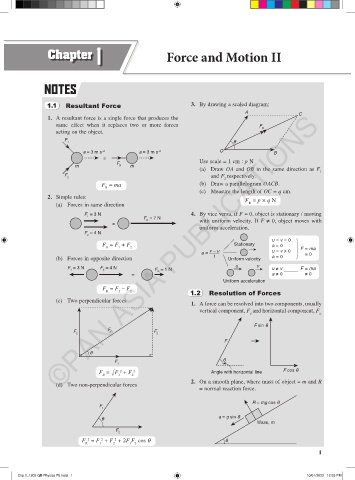
1. A resultant force is a single force that produces the
same effect when it replaces two or more forces F
R
acting on the object.
F
1 θ
a = 3 m s –2 a = 3 m s –2 O B
=
F Use scale = 1 cm : p N
m R m
(a) Draw OA and OB in the same direction as F
1
F and F respectively.
2 2
F = ma (b) Draw a parallelogram OACB.
R
(c) Measure the length of OC = q cm.
2. Simple rules:
F = p µ q N
(a) Forces in same direction R
F = 3 N 4. By vice versa, if F = 0, object is stationary / moving
1
F = 7 N
R with uniform velocity. If F ≠ 0, object moves with
=
uniform acceleration.
F = 4 N
2
u = v = 0
F = F + F Stationary a = 0
R 1 2 123 F = ma
v – u u = v ≠ 0
a = –––– = 0
(b) Forces in opposite direction t Uniform velocity a = 0
F = 3 N F = 4 N F = 1 N u v u ≠ v F = ma
1 2
R
= a ≠ 0 ≠ 0
Uniform acceleration
F = F – F
R 1 2 1.2 Resolution of Forces
(c) Two perpendicular forces
1. A force can be resolved into two components, usually
vertical component, F and horizontal component, F
y x.
F sin θ
F
F R F
2 2
F
θ
F 1 θ
2
F = F + F 2 Angle with horizontal line F cos θ
R 1 2
2. On a smooth plane, where mass of object = m and R
(d) Two non-perpendicular forces
= normal reaction force.
R = mg cos θ
F
1
a = g sin θ
θ
Mass, m
F
2
F = F + F + 2F F cos q θ
2
2
2
R 1 2 1 2
1
Chp 1_1202 QB Physics F5.indd 1 10/01/2022 12:33 PM

