


Page 8 - 1202 Question Bank Physics Form 5
P. 8
1.3 Forces in Equilibrium
1.4 Elasticity
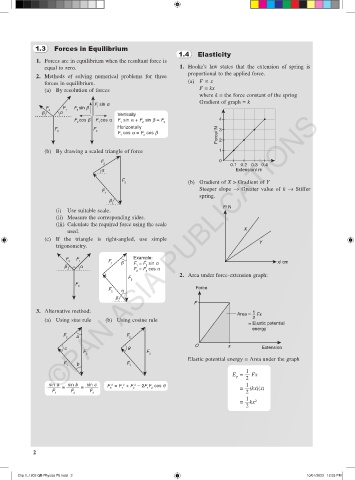
1. Forces are in equilibrium when the resultant force is
equal to zero. 1. Hooke’s law states that the extension of spring is
proportional to the applied force.
2. Methods of solving numerical problems for three
forces in equilibrium. (a) F ∝ x
(a) By resolution of forces F = kx
where k = the force constant of the spring
Gradient of graph = k
F sin α
F F F sin β 1 Vertically
2 1 2
β α F sin α + F sin β = F
Vertically 2 3
1
= ©PAN ASIA PUBLICATIONS
Horizontally
F cos β F cos α F sin a + F sin b = F 4
2 1 F cos α = F cos β 3
1
2
1
2
F F Horizontally 3
3 3 F cos a = F cos b
1 2 Force/ N 2
(b) By drawing a scaled triangle of force 1
F 0
2 0.1 0.2 0.3 0.4
α Extension/ m
F
3 (b) Gradient of X > Gradient of Y
Steeper slope ˜ Greater value of k ˜ Stiffer
F
1
spring.
β
F/ N
(i) Use suitable scale.
(ii) Measure the corresponding sides.
(iii) Calculate the required force using the scale
used. X
(c) If the triangle is right-angled, use simple
Y
trigonometry.
Example:
F F F F Example:
2 2 1 1 F F β β x/ cm
F = F sin α
1 1 F = F sin α
β β α α 1 1 3 3
F = F cos α
F = F cos α
2 2 3 3
2. Area under force-extension graph:
F F
3 3
F F
3 3
F F Force
2 2 α α
β β
F
3. Alternative method: 1
Area = – Fx
2
(a) Using sine rule (b) Using cosine rule
= Elastic potential
energy
sin a sin b sin c
2
2
2
F a –––– = –––– = –––– F = F + F – 2F F cos θ
F
2 F F 2 F 3 1 2 1 2
1 2 3
O x
c θ Extension
F F
3 3
Elastic potential energy = Area under the graph
F b F
1 1
1
E = Fx
P 2
sin a sin b sin c F = F + F – 2F F cos q 1
2
2
2
= 3 1 2 1 2 = (kx)(x)
F F F 2
1 2 3
1
= kx 2
2
2
Chp 1_1202 QB Physics F5.indd 2 10/01/2022 12:33 PM

