


Page 113 - Chronicles of Darkness
P. 113
Try to avoid using more than one statement from
                                                                      each player. You don’t want to write out a huge biogra-
                                                                      phy of the missing person; you simply want a framework
                                                                      to connect to and some tantalizing ideas to build from.

                                                                      What the Questions Really Answer
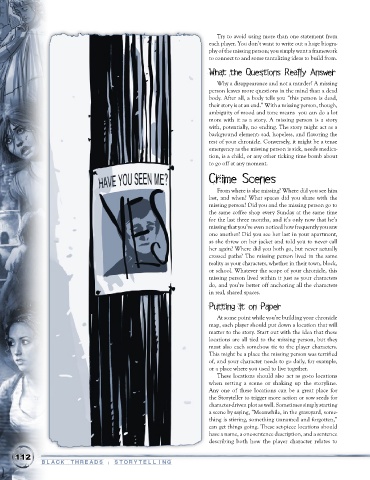
                                                                         Why a disappearance and not a murder? A missing
                                                                      person leaves more questions in the mind than a dead
                                                                      body. After all, a body tells you “this person is dead,
                                                                      their story is at an end.” With a missing person, though,
                                                                      ambiguity of mood and tone means  you can do a lot
                                                                      more with it as a story. A missing person is a story
                                                                      with, potentially, no ending. The story might act as a
                                                                      background element: sad, hopeless, and flavoring the
                                                                      rest of your chronicle. Conversely, it might be a tense
                                                                      emergency as the missing person is sick, needs medica-
                                                                      tion, is a child, or any other ticking time bomb about
                                                                      to go off at any moment.
                                                                      Crime Scenes


                                                                         From where is she missing? Where did you see him
                                                                      last, and when? What spaces did you share with the
                                                                      missing person? Did you and the missing person go to
                                                                      the same coffee shop every Sunday at the same time
                                                                      for the last three months, and it’s only now that he’s
                                                                      missing that you’ve even noticed how frequently you saw
                                                                      one another? Did you see her last in your apartment,
                                                                      as she threw on her jacket and told you to never call
                                                                      her again? Where did you both go, but never actually
                                                                      crossed paths? The missing person lived in the same
                                                                      reality as your characters, whether in their town, block,
                                                                      or school. Whatever the scope of your chronicle, this
                                                                      missing person lived within it just as your characters
                                                                      do, and you’re better off anchoring all the characters
                                                                      in real, shared spaces.
                                                                      Putting it on Paper

                                                                         At some point while you’re building your chronicle
                                                                      map, each player should put down a location that will
                                                                      matter to the story. Start out with the idea that these
                                                                      locations are all tied to the missing person, but they
                                                                      must also each somehow tie to the player characters.
                                                                      This might be a place the missing person was terrified
                                                                      of, and your character needs to go daily, for example,
                                                                      or a place where you used to live together.
                                                                         These locations should also act as go-to locations
                                                                      when setting a scene or shaking up the storyline.
                                                                      Any one of these locations can be a great place for
                                                                      the Storyteller to trigger more action or sow seeds for
                                                                      character-driven plot as well. Sometimes simply starting
                                                                      a scene by saying, “Meanwhile, in the graveyard, some-
                                                                      thing is stirring, something unnamed and forgotten,”
                                                                      can get things going. These set-piece locations should
                                                                      have a name, a one-sentence description, and a sentence
                                                                      describing both how the player character relates to

      112
               black threads-storytelling

