


Page 90 - 2010-2022 hose manufactureing ability and guide
P. 90
OIL AND GASOLINE RESISTANCE


                    Rubber  hose  is used to  convey petroleum   In this RMA classification, the rubber samples
                 products both  in the  crude  and  refined  stages.   are immersed in IRM 903 oil at 100°C for 70
                 The aromatic content  of  refined  gasoline is   hours. (See ASTM Method D-471 for a detailed
                 often adjusted to control the octane rating. The   description of the oil and the testing procedure.)
                 presence of aromatic hydrocarbons in this fuel   As a guide to the user of hose in contact with
                 generally has a greater effect on rubber       oil,  the oil resistance classes  and a
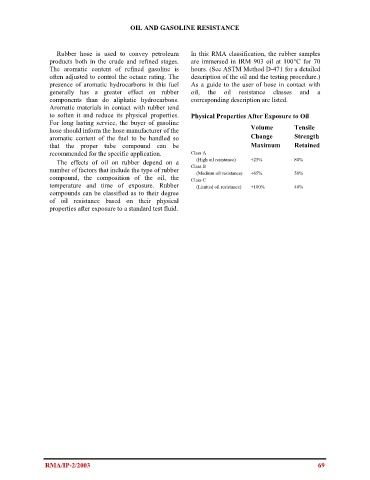
                 components than do aliphatic hydrocarbons.     corresponding description are listed.
                 Aromatic materials in contact with rubber tend
                 to soften it  and reduce  its physical  properties.   Physical Properties After Exposure to Oil
                 For long lasting service, the buyer of gasoline
                 hose should inform the hose manufacturer of the                                       Volume             Tensile
                 aromatic  content  of the  fuel to be  handled  so                                       Change             Strength
                 that  the proper  tube compound can  be                                            Maximum         Retained
                 recommended for the specific application.      Class A
                    The effects of oil  on rubber  depend  on a         (High oil resistance)            +25%                          80%
                 number of factors that include the type of rubber   Class B
                                                                      (Medium oil resistance)       +65%                          50%
                 compound, the  composition of the oil,  the    Class C
                 temperature  and time of  exposure.  Rubber          (Limited oil resistance)        +100%                        40%
                 compounds can be classified as to their degree
                 of oil  resistance based  on their  physical
                 properties after exposure to a standard test fluid.


                RMA/IP-2/2003                                                                             69

