


Page 140 - Towards Trustworthy Elections New Directions in Electronic Voting by Ed Gerck (auth.), David Chaum, Markus Jakobsson, Ronald L. Rivest, Peter Y. A. Ryan, Josh Benaloh, Miroslaw Kutylowski, Ben Adida ( (z-lib.org (1)
P. 140
Rezende
                                 P.A.D.
                          132
                            Then, after that deadline had elapsed and the crippled Bill was in the lower house,
                          the same president of the TSE – where electoral laws are interpreted – changed the
                                                                            14
                          story, suggesting that better it be voted on as an urgent matter , arguing that the mat-
                          ter could still go into effect for next election since it was, “after all, a technical mat-
                          ter”, and therefore beyond the constitutional restriction for electoral matters, of prior
                          approval by one year.
                            After the crippled Bill  was passed and  sanctioned as suggested, becoming  Law
                          number 10,408/02 (VVPAT Law), he invited some Congressmen to his office at the
                          Supreme Court to inform them that he had misunderstood the constitutional restric-
                          tion: such legal matter was indeed electoral in nature, and therefore the VVPAT Law
                          would not apply to the next election. As an excuse for his fumble, he offered to have
                          electoral authorities voluntarily "test", in 3% of the voting machines at the upcoming
                          2002 election (which included a bid for Brazil's presidency), the VVPAT mechanism
                          that  such  Law  had  made, as he  understood it then, obligatory only  for elections
                          scheduled to be held after 2003.
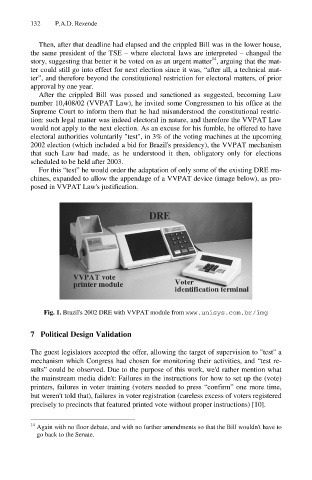
                            For this “test” he would order the adaptation of only some of the existing DRE ma-
                          chines, expanded to allow the appendage of a VVPAT device (image below), as pro-
                          posed in VVPAT Law's justification.


                              Fig. 1. Brazil's 2002 DRE with VVPAT module from www.unisys.com.br/img


                          7   Political Design Validation

                          The guest legislators accepted the offer, allowing the target of supervision to "test" a
                          mechanism which Congress had chosen for monitoring their activities, and “test re-
                          sults” could be observed. Due to the purpose of this work, we'd rather mention what
                          the mainstream media didn't: Failures in the instructions for how to set up the (vote)
                          printers, failures in voter training (voters needed to press “confirm” one more time,
                          but weren't told that), failures in voter registration (careless excess of voters registered
                          precisely to precincts that featured printed vote without proper instructions) [10].

                          14
                            Again with no floor debate, and with no further amendments so that the Bill wouldn't have to
                            go back to the Senate.

