


Page 258 - Towards Trustworthy Elections New Directions in Electronic Voting by Ed Gerck (auth.), David Chaum, Markus Jakobsson, Ronald L. Rivest, Peter Y. A. Ryan, Josh Benaloh, Miroslaw Kutylowski, Ben Adida ( (z-lib.org (1)
P. 258
S. Popoveniuc and B. Hosp
                          250
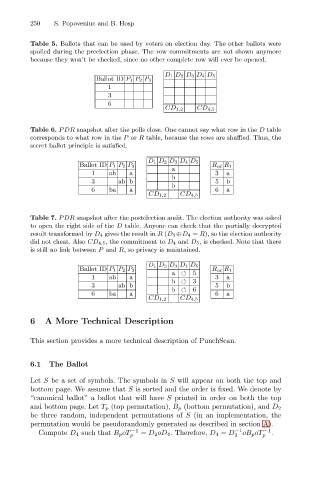
                          Table 5. Ballots that can be used by voters on election day. The other ballots were
                          spoiled during the preelection phase. The row commitments are not shown anymore
                          because they won’t be checked, since no other complete row will ever be opened.
                                                               D 1 D 2 D 3 D 4 D 5
                                            Ballot ID P 1 P 2 P 3
                                               1
                                               3
                                               6
                                                               CD 1,2   CD 4,5
                          Table 6. PDR snapshot after the polls close. One cannot say what row in the D table
                          corresponds to what row in the P or R table, because the rows are shuffled. Thus, the
                          secret ballot principle is satisfied.
                                                          D 1 D 2 D 3 D 4 D 5
                                       Ballot ID P 1 P 2 P 3                R id R 1
                                                                 a
                                           1    ab   a                       3  a
                                                                 b
                                           3      ab b                       5  b
                                                                 b
                                           6    ba   a                       6  a
                                                          CD 1,2   CD 4,5
                          Table 7. PDR snapshot after the postelection audit. The election authority was asked
                          to open the right side of the D table. Anyone can check that the partially decrypted
                          result transformed by D 4 gives the result in R (D 3 ⊕D 4 = R), so the election authority
                          did not cheat. Also CD 4,5, the commitment to D 4 and D 5, is checked. Note that there
                          is still no link between P and R, so privacy is maintained.

                                                          D 1 D 2 D 3 D 4 D 5
                                       Ballot ID P 1 P 2 P 3                R id R 1
                                                                 a   5
                                           1    ab   a                       3  a
                                                                 b   3
                                           3      ab b                       5  b
                                                                 b   6
                                           6    ba   a                       6  a
                                                          CD 1,2   CD 4,5
                          6   A More Technical Description


                          This section provides a more technical description of PunchScan.


                          6.1  The Ballot

                          Let S be a set of symbols. The symbols in S will appear on both the top and
                          bottom page. We assume that S is sorted and the order is fixed. We denote by
                          “canonical ballot” a ballot that will have S printed in order on both the top
                          and bottom page. Let T p (top permutation), B p (bottom permutation), and D 2
                          be three random, independent permutations of S (in an implementation, the
                          permutation would be pseudorandomly generated as described in section A).
                            Compute D 4 such that B p oT p −1  = D 2 oD 4 . Therefore, D 4 = D −1 oB p oT p −1 .
                                                                                  2

