


Page 315 - Towards Trustworthy Elections New Directions in Electronic Voting by Ed Gerck (auth.), David Chaum, Markus Jakobsson, Ronald L. Rivest, Peter Y. A. Ryan, Josh Benaloh, Miroslaw Kutylowski, Ben Adida ( (z-lib.org (1)
P. 315
Verifying Privacy-Type Properties of Electronic Voting Protocols: A Taster
                           processV =
                               (* her private key *)
                               in ( skvCh , skv ) . out (chc , skv ) .
                               (* public keys of the administrator *)                       307
                               in ( pkaCh1 , pubka ) .  out ( chc , pubka ) .
                               ν bl in der . ν r.  ν td .
                               out (chc , b l i n d e r ) . out (chc , f (a , r , td , c )) . out (chc , td ) .
                               let committedvote = tdcommit (a , r , td ) in
                               let bl i ndedcom m i ttedvote=b l i n d ( committedvote , b l i n d e r ) in
                               out ( ch1 , ( pk ( skv ) , si gn ( blindedcommittedvote , skv ) ) ) .
                               out ( chc , ( pk ( skv ) , si gn ( blindedcommittedvote , skv ) ) ) .
                               in (ch2 ,m2) .
                               let r e s u l t = checksi gn (m2, pubka ) in
                               if r e s u l t = bl i ndedcom m i ttedvote then
                               let signedcommittedvote=unbl i nd (m2, b l i n d e r ) in
                               synch 1 .
                               out ( ch3 , ( committedvote , signedcommittedvote )) .
                               out ( chc , ( committedvote , signedcommittedvote )) .
                               out (chT , ( a , r , committedvote )) .
                               out ( chc , ( c , f (a , r , td , c ) , committedvote ))

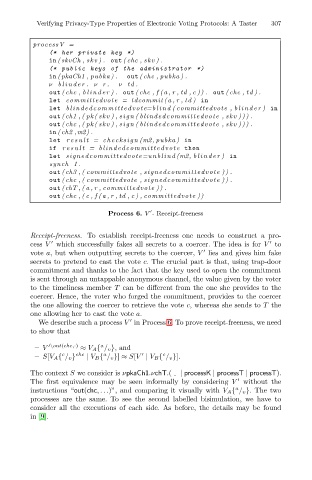
                                               Process 6. V - Receipt-freeness


                          Receipt-freeness. To establish receipt-freeness one needs to construct a pro-
                          cess V which successfully fakes all secrets to a coercer. The idea is for V to


                          vote a, but when outputting secrets to the coercer, V lies and gives him fake

                          secrets to pretend to cast the vote c. The crucial part is that, using trap-door
                          commitment and thanks to the fact that the key used to open the commitment
                          is sent through an untappable anonymous channel, the value given by the voter
                          to the timeliness member T can be different from the one she provides to the
                          coercer. Hence, the voter who forged the commitment, provides to the coercer
                          the one allowing the coercer to retrieve the vote c, whereas she sends to T the
                          one allowing her to cast the vote a.
                            We describe such a process V in Process 6. To prove receipt-freeness, we need

                          to show that
                                             a
                           – V   \out(chc,·)  ≈ V A { / v },and
                                   c  chc     a               c
                           – S[V A { / v }  | V B { / v }] ≈ S[V | V B { / v }].
                          The context S we consider is νpkaCh1.νchT.(  | processK | processT | processT).
                          The first equivalence may be seen informally by considering V without the

                                                                                  a
                          instructions “out(chc,...)”, and comparing it visually with V A { / v }.The two
                          processes are the same. To see the second labelled bisimulation, we have to
                          consider all the executions of each side. As before, the details may be found
                          in [9].

