


Page 316 - Towards Trustworthy Elections New Directions in Electronic Voting by Ed Gerck (auth.), David Chaum, Markus Jakobsson, Ronald L. Rivest, Peter Y. A. Ryan, Josh Benaloh, Miroslaw Kutylowski, Ben Adida ( (z-lib.org (1)
P. 316
S. Delaune, S. Kremer, and M. Ryan
                          308
                              Conclusion
                          7
                          We have defined a framework for modelling cryptographic voting protocols in
                          the applied pi calculus, and shown how to express in it the properties of vote-
                          privacy, receipt-freeness and coercion-resistance. Within the framework, we can
                          stipulate which parties are assumed to be trustworthy in order to obtain the
                          desired property. We investigated two protocols from the literature. Our results
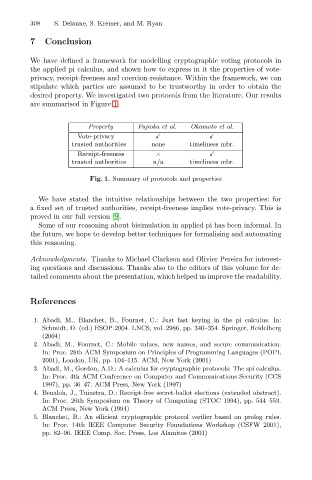
                          are summarised in Figure 1.
                                          Property      Fujioka et al.  Okamoto et al.
                                       Vote-privacy
                                     trusted authorities   none       timeliness mbr.
                                       Receipt-freeness     ×
                                     trusted authorities    n/a       timeliness mbr.

                                          Fig. 1. Summary of protocols and properties

                            We have stated the intuitive relationships between the two properties: for
                          a fixed set of trusted authorities, receipt-freeness implies vote-privacy. This is
                          proved in our full version [9].
                            Some of our reasoning about bisimulation in applied pi has been informal. In
                          the future, we hope to develop better techniques for formalising and automating
                          this reasoning.

                          Acknowledgments. Thanks to Michael Clarkson and Olivier Pereira for interest-
                          ing questions and discussions. Thanks also to the editors of this volume for de-
                          tailed comments about the presentation, which helped us improve the readability.


                          References

                           1. Abadi, M., Blanchet, B., Fournet, C.: Just fast keying in the pi calculus. In:
                             Schmidt, D. (ed.) ESOP 2004. LNCS, vol. 2986, pp. 340–354. Springer, Heidelberg
                             (2004)
                           2. Abadi, M., Fournet, C.: Mobile values, new names, and secure communication.
                             In: Proc. 28th ACM Symposium on Principles of Programming Languages (POPL
                             2001), London, UK, pp. 104–115. ACM, New York (2001)
                           3. Abadi, M., Gordon, A.D.: A calculus for cryptographic protocols: The spi calculus.
                             In: Proc. 4th ACM Conference on Computer and Communications Security (CCS
                             1997), pp. 36–47. ACM Press, New York (1997)
                           4. Benaloh, J., Tuinstra, D.: Receipt-free secret-ballot elections (extended abstract).
                             In: Proc. 26th Symposium on Theory of Computing (STOC 1994), pp. 544–553.
                             ACM Press, New York (1994)
                           5. Blanchet, B.: An efficient cryptographic protocol verifier based on prolog rules.
                             In: Proc. 14th IEEE Computer Security Foundations Workshop (CSFW 2001),
                             pp. 82–96. IEEE Comp. Soc. Press, Los Alamitos (2001)

