


Page 53 - Towards Trustworthy Elections New Directions in Electronic Voting by Ed Gerck (auth.), David Chaum, Markus Jakobsson, Ronald L. Rivest, Peter Y. A. Ryan, Josh Benaloh, Miroslaw Kutylowski, Ben Adida ( (z-lib.org (1)
P. 53
45
                                                            Coercion-Resistant Electronic Elections
                          in interaction with components of the election system ES. This adversary is assumed to
                          retain state throughout the duration of an experiment. We formulate our experiments
                          such that in all cases, the aim of the adversary is to cause an output value of ‘1’.
                          Thus, for experiment Exp E  (·) on property E ∈ (ver, corr, c-resist),wedefine
                                                ES,A
                              E              E
                          Succ    (·)= Pr[Exp    (·)= ‘1’].
                              ES,A           ES,A
                            According to the standard definition, we say that a quantity f(k) is negligible in
                          k if for every positive integer c there is some l c such that f(k) <k −c  for k> l c .
                          In most cases, we use the term negligible alone to mean negligible with respect to
                          the full set of relevant security parameters. Similarly, in saying that an algorithm has
                          polynomial running time, we mean that its running time is asymptotically bounded by
                          some polynomial in the relevant security parameters. As the properties of correctness
                          and verifiability are genearl ones that apply to any voting scheme, we discuss them first.
                          We then consider coercion resistance, the special focus of our work here.
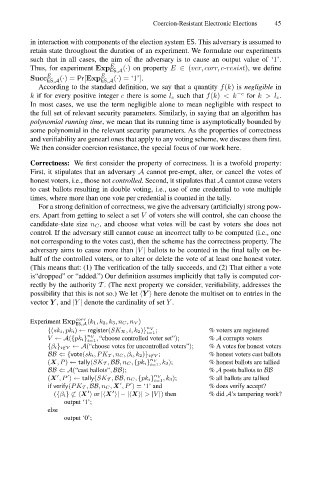
                          Correctness: We first consider the property of correctness. It is a twofold property:
                          First, it stipulates that an adversary A cannot pre-empt, alter, or cancel the votes of
                          honest voters, i.e., those not controlled. Second, it stipulates that A cannot cause voters
                          to cast ballots resulting in double voting, i.e., use of one credential to vote multiple
                          times, where more than one vote per credential is counted in the tally.
                            For a strong definition of correctness, we give the adversary (artificially) strong pow-
                          ers. Apart from getting to select a set V of voters she will control, she can choose the
                          candidate-slate size n C , and choose what votes will be cast by voters she does not
                          control. If the adversary still cannot cause an incorrect tally to be computed (i.e., one
                          not corresponding to the votes cast), then the scheme has the correctness property. The
                          adversary aims to cause more than |V | ballots to be counted in the final tally on be-
                          half of the controlled voters, or to alter or delete the vote of at least one honest voter.
                          (This means that: (1) The verification of the tally succeeds, and (2) That either a vote
                          is“dropped” or “added.”) Our definition assumes implicitly that tally is computed cor-
                          rectly by the authority T . (The next property we consider, verifiability, addresses the
                          possibility that this is not so.) We let  Y   here denote the multiset on to entries in the
                          vector Y ,and |Y | denote the cardinality of set Y .


                          Experiment Exp corr  (k 1,k 2,k 3,n C ,n V )
                                      ES,A
                                                          n V
                               {(sk i,pk i) ← register(SK R,i,k 2)} i=1 ;  % voters are registered
                                          n V
                               V ←A({pk i} i=1 , “choose controlled voter set”);  % A corrupts voters
                               {β i} i ∈V ←A(“choose votes for uncontrolled voters”);  % A votes for honest voters
                               BB ⇐ {vote(sk i,PK T ,n C ,β i,k 2)} i ∈V ;  % honest voters cast ballots
                                                           n V
                               (X,P) ← tally(SK T , BB,n C , {pk i} i=1 ,k 3);  % honest ballots are tallied
                               BB ⇐ A(“cast ballots”, BB);                 % A posts ballots to BB
                                                            n V
                               (X ,P ) ← tally(SK T , BB,n C , {pk i} i=1 ,k 3);  % all ballots are tallied

                               if verify(PK T , BB,n C , X ,P )= ‘1’ and   % does verify accept?

                                ({β i}  ⊂ X   or | X  | − | X | > |V |) then  % did A’s tampering work?


                                   output ‘1’;
                               else
                                   output ‘0’;

