


Page 57 - Towards Trustworthy Elections New Directions in Electronic Voting by Ed Gerck (auth.), David Chaum, Markus Jakobsson, Ronald L. Rivest, Peter Y. A. Ryan, Josh Benaloh, Miroslaw Kutylowski, Ben Adida ( (z-lib.org (1)
P. 57
Coercion-Resistant Electronic Elections
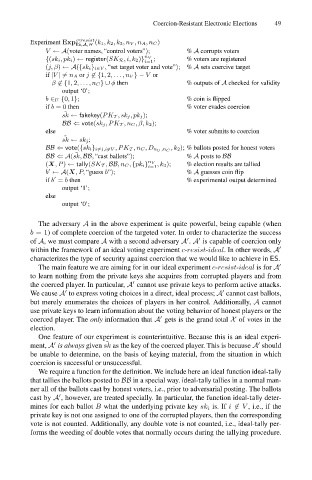
                                      c-resist
                          Experiment Exp
                                            (k 1,k 2,k 3,n V ,n A,n C )
                                      ES,A,H
                              V ←A(voter names, “control voters”);
                                                                     % A corrupts voters
                                                         n V
                                                            ;
                                                                     % voters are registered
                              {(sk i,pk i) ← register(SK R,i,k 2)}
                                                         i=1
                              (j, β) ←A({sk i} i∈V , “set target voter and vote”); % A sets coercive target  49
                              if |V |  = n A or j  ∈{1, 2, ...,n V }− V or
                                β  ∈{1, 2, ...,n C }∪ φ then         % outputs of A checked for validity
                                   output ‘0’;
                              b ∈ U {0, 1};                          % coin is flipped
                              if b =0 then                           % voter evades coercion
                                   ˜
                                   sk ← fakekey(PK T ,sk j,pk j);
                                   BB ⇐ vote(sk j,PK T ,n C ,β,k 2);
                              else                                   % voter submits to coercion
                                   ˜
                                   sk ← sk j;
                                                                 ,k 2); % ballots posted for honest voters
                              BB ⇐ vote({sk i} i =j,i ∈V ,PK T ,n C ,D n U ,n C
                                      ˜
                              BB ⇐ A(sk, BB, “cast ballots”);        % A posts to BB
                                                          n V
                              (X,P) ← tally(SK T , BB,n C , {pk i}  ,k 3);  % election results are tallied
                                                          i=1

                              b ←A(X,P, “guess b”);                  % A guesses coin flip
                              if b = b then                          % experimental output determined

                                   output ‘1’;
                              else
                                   output ‘0’;
                            The adversary A in the above experiment is quite powerful, being capable (when
                          b =1) of complete coercion of the targeted voter. In order to characterize the success

                          of A, we must compare A with a second adversary A . A is capable of coercion only


                          within the framework of an ideal voting experiment c-resist-ideal.Inother words, A
                          characterizes the type of security against coercion that we would like to achieve in ES.

                            The main feature we are aiming for in our ideal experiment c-resist-ideal is for A
                          to learn nothing from the private keys she acquires from corrupted players and from
                          the coerced player. In particular, A cannot use private keys to perform active attacks.

                          We cause A to express voting choices in a direct, ideal process; A cannot cast ballots,


                          but merely enumerates the choices of players in her control. Additionally, A cannot
                          use private keys to learn information about the voting behavior of honest players or the
                          coerced player. The only information that A gets is the grand total X of votes in the

                          election.
                            One feature of our experiment is counterintuitive. Because this is an ideal experi-
                                               ˜

                          ment, A is always given sk as the key of the coerced player. This is because A should

                          be unable to determine, on the basis of keying material, from the situation in which
                          coercion is successful or unsuccessful.
                            We require a function for the definition. We include here an ideal function ideal-tally
                          that tallies the ballots posted to BB in a special way. ideal-tally tallies in a normal man-
                          ner all of the ballots cast by honest voters, i.e., prior to adversarial posting. The ballots
                          cast by A , however, are treated specially. In particular, the function ideal-tally deter-

                          mines for each ballot B what the underlying private key sk i is. If i   V , i.e., if the
                                                                                  ∈
                          private key is not one assigned to one of the corrupted players, then the corresponding
                          vote is not counted. Additionally, any double vote is not counted, i.e., ideal-tally per-
                          forms the weeding of double votes that normally occurs during the tallying procedure.

