


Page 54 - Towards Trustworthy Elections New Directions in Electronic Voting by Ed Gerck (auth.), David Chaum, Markus Jakobsson, Ronald L. Rivest, Peter Y. A. Ryan, Josh Benaloh, Miroslaw Kutylowski, Ben Adida ( (z-lib.org (1)
P. 54
A. Juels, D. Catalano, and M. Jakobsson
                          46
                          We say that ES possesses the property of correctness if for all polynomial-time adver-
                                                    corr
                                                       (k 1 ,k 2 ,k 3 ,n V ) is negligible.
                          saries A, it is the case that Succ
                                                    ES,A
                          Verifiability: As explained above, an election system has the property of correctness
                          if computation of tally always yields a valid tabulation of ballots. Given the ability of
                          an adversary A, however, to corrupt some number of authorities among T , we cannot
                          be assured that tally is always computed correctly. The property of verifiability is the
                          ability for any player to check whether the tally X has been correctly computed, that
                          is, to detect any misbehavior by T in applying the function tally.
                            A strong security definition for verifiability is appropriate given the high level of
                          auditability required for trustworthy elections. Such a definition considers an attacker
                          A capable of controlling all of the voters and tallying authorities in T . This attacker
                          seeks to construct a set of ballots on BB and a corresponding tally X and proof P of
                          correct tabulation such that the proof is accepted by verify, but the tally is in fact incor-
                          rect. By an incorrect tally, we mean one in which all of the valid ballots of a particular
                          voter (i.e., corresponding to a particular credential) are discounted, or else where mul-
                          tiple votes are tallied that could have been generated by the same voting credential. Our
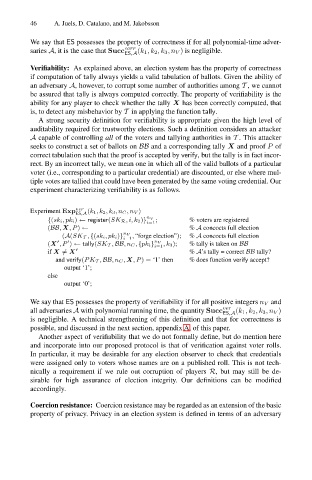
                          experiment characterizing verifiability is as follows.
                          Experiment Exp ver  (k 1,k 2,k 3,n C ,n V )
                                      ES,A
                                                          n V
                               {(sk i,pk i) ← register(SK R,i,k 2)} i=1 ;  % voters are registered
                               (BB, X,P) ←                            % A concocts full election
                                                   n V
                                   (A(SK T , {(sk i,pk i)} i=1 , “forge election”);  % A concocts full election
                                                            n V
                               (X ,P ) ← tally(SK T , BB,n C , {pk i} i=1 ,k 3);  % tally is taken on BB
                               if X  = X                              % A’s tally = correct BB tally?
                                 and verify(PK T , BB,n C , X,P)= ‘1’ then  % does function verify accept?
                                   output ‘1’;
                               else
                                   output ‘0’;

                          We say that ES possesses the property of verifiability if for all positive integers n V and
                          all adversaries A with polynomial running time, the quantity Succ ver  (k 1 ,k 2 ,k 3 ,n V )
                                                                               ES,A
                          is negligible. A technical strengthening of this definition and that for correctness is
                          possible, and discussed in the next section, appendix A, of this paper.
                            Another aspect of verifiability that we do not formally define, but do mention here
                          and incorporate into our proposed protocol is that of verification against voter rolls.
                          In particular, it may be desirable for any election observer to check that credentials
                          were assigned only to voters whose names are on a published roll. This is not tech-
                          nically a requirement if we rule out corruption of players R, but may still be de-
                          sirable for high assurance of election integrity. Our definitions can be modified
                          accordingly.

                          Coercion resistance: Coercion resistance may be regarded as an extension of the basic
                          property of privacy. Privacy in an election system is defined in terms of an adversary

