


Page 58 - Towards Trustworthy Elections New Directions in Electronic Voting by Ed Gerck (auth.), David Chaum, Markus Jakobsson, Ronald L. Rivest, Peter Y. A. Ryan, Josh Benaloh, Miroslaw Kutylowski, Ben Adida ( (z-lib.org (1)
P. 58
A. Juels, D. Catalano, and M. Jakobsson
                          50
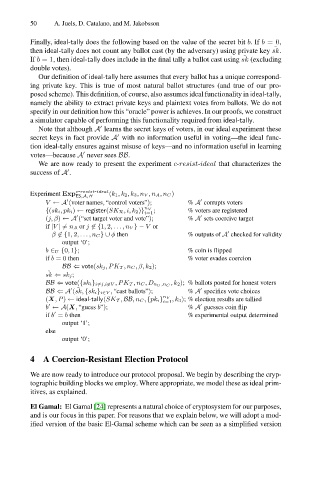
                          Finally, ideal-tally does the following based on the value of the secret bit b.If b =0,
                          then ideal-tally does not count any ballot cast (by the adversary) using private key sk.
                          If b =1,then ideal-tally does include in the final tally a ballot cast using sk (excluding
                          double votes).                                             ˜       ˜
                            Our definition of ideal-tally here assumes that every ballot has a unique correspond-
                          ing private key. This is true of most natural ballot structures (and true of our pro-
                          posed scheme). This definition, of course, also assumes ideal functionality in ideal-tally,
                          namely the ability to extract private keys and plaintext votes from ballots. We do not
                          specify in our definition how this “oracle” power is achieves. In our proofs, we construct
                          a simulator capable of performing this functionality required from ideal-tally.
                            Note that although A learns the secret keys of voters, in our ideal experiment these

                          secret keys in fact provide A with no information useful in voting—the ideal func-

                          tion ideal-tally ensures against misuse of keys—and no information useful in learning
                          votes—because A never sees BB.

                            We are now ready to present the experiment c-resist-ideal that characterizes the
                          success of A .

                          Experiment Exp c-resist-ideal (k 1,k 2,k 3,n V ,n A,n C )
                                      ES,A,H
                              V ←A (voter names, “control voters”);  % A corrupts voters


                                                         n V
                              {(sk i,pk i) ← register(SK R,i,k 2)}  ;  % voters are registered
                                                         i=1
                              (j, β) ←A (“set target voter and vote”);  % A sets coercive target


                              if |V |  = n A or j  ∈{1, 2, ...,n V }− V or

                                β  ∈{1, 2, ...,n C }∪ φ then         % outputs of A checked for validity
                                   output ‘0’;
                              b ∈ U {0, 1};                          % coin is flipped
                              if b =0 then                           % voter evades coercion
                                   BB ⇐ vote(sk j,PK T ,n C ,β,k 2);
                               ˜
                              sk ⇐ sk j;
                                                                 ,k 2); % ballots posted for honest voters
                              BB ⇐ vote({sk i} i =j,i ∈V ,PK T ,n C ,D n U ,n C
                                       ˜

                              BB ⇐ A (sk, {sk i} i∈V , “cast ballots”);  % A specifies vote choices
                                                              n V
                              (X,P) ← ideal-tally(SK T , BB,n C , {pk i} i=1 ,k 3); % election results are tallied


                              b ←A(X, “guess b”);                    % A guesses coin flip

                              if b = b then                          % experimental output determined
                                   output ‘1’;
                              else
                                   output ‘0’;
                          4 A Coercion-Resistant Election Protocol
                          We are now ready to introduce our protocol proposal. We begin by describing the cryp-
                          tographic building blocks we employ. Where appropriate, we model these as ideal prim-
                          itives, as explained.
                          El Gamal: El Gamal [24] represents a natural choice of cryptosystem for our purposes,
                          and is our focus in this paper. For reasons that we explain below, we will adopt a mod-
                          ified version of the basic El-Gamal scheme which can be seen as a simplified version

