


Page 155 - Towards_a_New_Malaysia_The_2018_Election_and_Its_6146371_(z-lib.org)
P. 155
140                                                     Haris Zuan

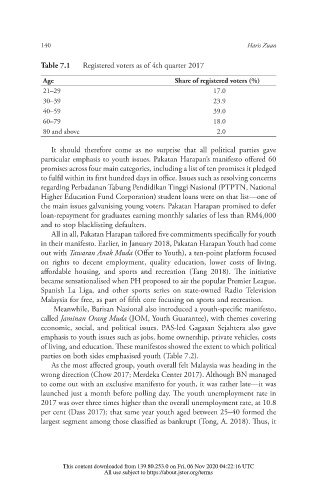
                  Table 7.1   Registered voters as of 4th quarter 2017

                   Age                                Share of registered voters (%)
                   21–29                                         17.0
                   30–39                                         23.9
                   40–59                                         39.0
                   60–79                                         18.0
                   80 and above                                   2.0

                     It should therefore come as no surprise that all political parties gave
                  particular emphasis to youth issues. Pakatan Harapan’s manifesto o ered 60
                  promises across four main categories, including a list of ten promises it pledged
                  to ful l within its  rst hundred days in o ce. Issues such as resolving concerns
                  regarding Perbadanan Tabung Pendidikan Tinggi Nasional (PTPTN, National
                  Higher Education Fund Corporation) student loans were on that list—one of
                  the main issues galvanising young voters. Pakatan Harapan promised to defer
                  loan-repayment for graduates earning monthly salaries of less than RM4,000
                  and to stop blacklisting defaulters.
                     All in all, Pakatan Harapan tailored  ve commitments speci cally for youth
                  in their manifesto. Earlier, in January 2018, Pakatan Harapan Youth had come
                  out with Tawaran Anak Muda (O er to Youth), a ten-point platform focused
                  on  rights to decent employment, quality education,  lower  costs  of living,
                  a ordable housing, and sports and recreation (Tang 2018).  e initiative
                  became sensationalised when PH proposed to air the popular Premier League,
                  Spanish La Liga, and other sports series on state-owned Radio  Television
                  Malaysia for free, as part of  fth core focusing on sports and recreation.
                      Meanwhile, Barisan Nasional also introduced a youth-speci c manifesto,
                  called Jaminan Orang Muda (JOM, Youth Guarantee), with themes covering
                  economic,  social,  and  political  issues.  PAS-led  Gagasan  Sejahtera  also  gave
                  emphasis to youth issues such as jobs, home ownership, private vehicles, costs
                  of living, and education.  ese manifestos showed the extent to which political
                  parties on both sides emphasised youth (Table 7.2).
                     As the most a ected group, youth overall felt Malaysia was heading in the
                  wrong direction (Chow 2017; Merdeka Center 2017). Although BN managed
                  to come out with an exclusive manifesto for youth, it was rather late—it was
                  launched just a month before polling day.  e youth unemployment rate in
                  2017 was over three times higher than the overall unemployment rate, at 10.8
                  per cent (Dass 2017); that same year youth aged between 25–40 formed the
                  largest segment among those classi ed as bankrupt (Tong, A. 2018).  us, it


                        This content downloaded from 139.80.253.0 on Fri, 06 Nov 2020 04:22:16 UTC
                                   All use subject to https://about.jstor.org/terms

