


Page 220 - Towards_a_New_Malaysia_The_2018_Election_and_Its_6146371_(z-lib.org)
P. 220
e Battle of Bangi                                           205

                  Omar admitted that his entry into electoral politics was intended for national
                  impact, especially on Malay voters in the Klang Valley, acknowledging that
                  PAS supporters on the east coast were highly loyal to the party (interview, Nik
                  Omar, 23 May 2018).
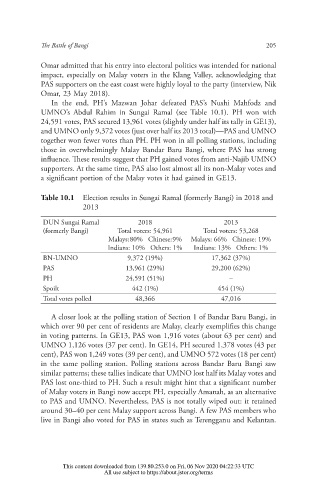
                     In the end, PH’s Mazwan Johar defeated PAS’s Nushi Mahfodz and
                  UMNO’s Abdul Rahim in Sungai Ramal (see Table 10.1). PH won with
                  24,591 votes, PAS secured 13,961 votes (slightly under half its tally in GE13),
                  and UMNO only 9,372 votes (just over half its 2013 total)—PAS and UMNO
                  together won fewer votes than PH. PH won in all polling stations, including
                  those in overwhelmingly Malay Bandar Baru Bangi, where PAS has strong
                  in uence.  ese results suggest that PH gained votes from anti-Najib UMNO
                  supporters. At the same time, PAS also lost almost all its non-Malay votes and
                  a signi cant portion of the Malay votes it had gained in GE13.

                  Table 10.1  Election results in Sungai Ramal (formerly Bangi) in 2018 and
                              2013

                   DUN Sungai Ramal         2018                    2013
                   (formerly Bangi)    Total voters: 54,961   Total voters: 53,268
                                    Malays: 80%   Chinese: 9%   Malays: 66%   Chinese: 19%
                                    Indians: 10%   Others: 1%  Indians: 13%   Others: 1%
                   BN-UMNO                9,372 (19%)           17,362 (37%)
                   PAS                   13,961 (29%)           29,200 (62%)
                   PH                    24,591 (51%)                –
                   Spoilt                  442 (1%)               454 (1%)
                   Total votes polled       48,366                 47,016

                     A closer look at the polling station of Section 1 of Bandar Baru Bangi, in
                  which over 90 per cent of residents are Malay, clearly exempli es this change
                  in voting patterns. In GE13, PAS won 1,916 votes (about 63 per cent) and
                  UMNO 1,126 votes (37 per cent). In GE14, PH secured 1,378 votes (43 per
                  cent), PAS won 1,249 votes (39 per cent), and UMNO 572 votes (18 per cent)
                  in the same polling station. Polling stations across Bandar Baru Bangi saw
                  similar patterns; these tallies indicate that UMNO lost half its Malay votes and
                  PAS lost one-third to PH. Such a result might hint that a signi cant number
                  of Malay voters in Bangi now accept PH, especially Amanah, as an alternative
                  to PAS and UMNO. Nevertheless, PAS is not totally wiped out: it retained
                  around 30–40 per cent Malay support across Bangi. A few PAS members who
                  live in Bangi also voted for PAS in states such as Terengganu and Kelantan.


                        This content downloaded from 139.80.253.0 on Fri, 06 Nov 2020 04:22:33 UTC
                                   All use subject to https://about.jstor.org/terms

