


Page 228 - Towards_a_New_Malaysia_The_2018_Election_and_Its_6146371_(z-lib.org)
P. 228
Malaysia’s First-Past-the-Post Electoral System              213

                     members sixteen should be elected in North Borneo [Sabah] and twenty-four
                     in  Sarawak.  e proportion  that  the number of seats  allocated  respectively
                     to Sarawak and to North Borneo bears to the total number of seats in the
                     House should not be reduced (except by reason of the granting of seats to any
                     other new State) during a period of seven years after Malaysia Day without
                     the concurrence of the Government of the State concerned, and thereafter
                     (except as aforesaid) shall be subject to Article 159 (3) of the existing Federal
                     Constitution (which requires Bills making amendments to the Constitution to
                     be supported in each House of Parliament by the votes of not less than two-
                     thirds of the total number of members of that House).
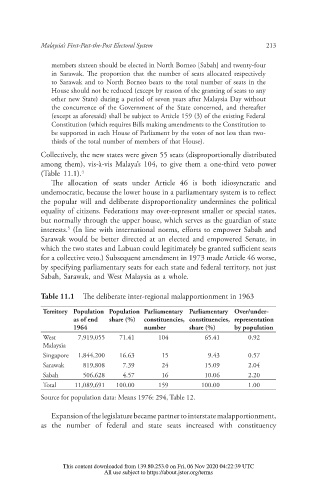
                  Collectively, the new states were given 55 seats (disproportionally distributed
                  among them), vis-à-vis Malaya’s 104, to give them a one-third veto power
                             4
                  (Table 11.1).
                      e allocation of seats under Article 46 is both idiosyncratic and
                  undemocratic, because the lower house in a parliamentary system is to re ect
                  the popular will and deliberate disproportionality undermines the political
                  equality of citizens. Federations may over-represent smaller or special states,
                  but normally through the upper house, which serves as the guardian of state
                  interests.  (In line with international norms, e orts to empower Sabah and
                         5
                  Sarawak  would  be  better  directed  at  an  elected  and  empowered Senate, in
                  which the two states and Labuan could legitimately be granted su cient seats
                  for a collective veto.) Subsequent amendment in 1973 made Article 46 worse,
                  by specifying parliamentary seats for each state and federal territory, not just
                  Sabah, Sarawak, and West Malaysia as a whole.


                  Table 11.1   e deliberate inter-regional malapportionment in 1963

                   Territory Population  Population  Parliamentary  Parliamentary  Over/under-
                           as of end   share (%)  constituencies,  constituencies,  representation
                           1964               number      share (%)   by population
                   West     7,919,055  71.41      104           65.41     0.92
                   Malaysia
                   Singapore  1,844,200  16.63     15          9.43       0.57
                   Sarawak    819,808   7.39       24         15.09       2.04
                   Sabah      506,628   4.57       16         10.06       2.20
                   Total   11,089,691  100.00     159         100.00      1.00
                  Source for population data: Means 1976: 294, Table 12.

                     Expansion of the legislature became partner to interstate malapportionment,
                  as the number of federal and state seats increased with constituency


                        This content downloaded from 139.80.253.0 on Fri, 06 Nov 2020 04:22:39 UTC
                                   All use subject to https://about.jstor.org/terms

