


Page 34 - Towards_a_New_Malaysia_The_2018_Election_and_Its_6146371_(z-lib.org)
P. 34
How Malaysia Voted in 2018                                    19

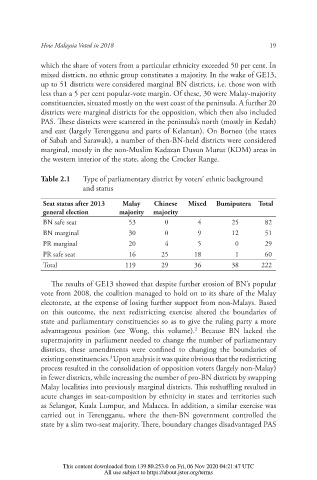
                  which the share of voters from a particular ethnicity exceeded 50 per cent. In
                  mixed districts, no ethnic group constitutes a majority. In the wake of GE13,
                  up to 51 districts were considered marginal BN districts, i.e. those won with
                  less than a 5 per cent popular-vote margin. Of these, 30 were Malay-majority
                  constituencies, situated mostly on the west coast of the peninsula. A further 20
                  districts were marginal districts for the opposition, which then also included
                  PAS.  ese districts were scattered in the peninsula’s north (mostly in Kedah)
                  and east (largely Terengganu and parts of Kelantan). On Borneo (the states
                  of Sabah and Sarawak), a number of then-BN-held districts were considered
                  marginal, mostly in the non-Muslim Kadazan Dusun Murut (KDM) areas in
                  the western interior of the state, along the Crocker Range.

                  Table 2.1   Type of parliamentary district by voters’ ethnic background
                              and status
                   Seat status after 2013   Malay   Chinese   Mixed  Bumiputera  Total
                   general election    majority  majority
                   BN safe seat           53        0        4        25       82
                   BN marginal            30        0        9        12       51
                   PR marginal            20        4        5         0       29
                   PR safe seat           16       25       18         1       60
                   Total                 119       29       36        38      222

                      e results of GE13 showed that despite further erosion of BN’s popular
                  vote from 2008, the coalition managed to hold on to its share of the Malay
                  electorate, at the expense of losing further support from non-Malays. Based
                  on  this  outcome,  the next redistricting exercise  altered  the  boundaries of
                  state and parliamentary constituencies so as to give the ruling party a more
                  advantageous position (see  Wong, this volume).  Because BN lacked the
                                                            2
                  supermajority in parliament needed to change the number of parliamentary
                  districts, these amendments were con ned to changing the boundaries of
                  existing constituencies. Upon analysis it was quite obvious that the redistricting
                                     3
                  process resulted in the consolidation of opposition voters (largely non-Malay)
                  in fewer districts, while increasing the number of pro-BN districts by swapping
                  Malay localities into previously marginal districts.  is reshu ing resulted in
                  acute changes in seat-composition by ethnicity in states and territories such
                  as Selangor, Kuala Lumpur, and Malacca. In addition, a similar exercise was
                  carried out in Terengganu, where the then-BN government controlled the
                  state by a slim two-seat majority.  ere, boundary changes disadvantaged PAS


                        This content downloaded from 139.80.253.0 on Fri, 06 Nov 2020 04:21:47 UTC
                                   All use subject to https://about.jstor.org/terms

