


Page 35 - Towards_a_New_Malaysia_The_2018_Election_and_Its_6146371_(z-lib.org)
P. 35
20                                        Ibrahim Su an and Lee Tai De

                  (based on GE13 results) in as many as six state constituencies, by reallocating
                  pro-BN villages and localities to marginal constituencies.
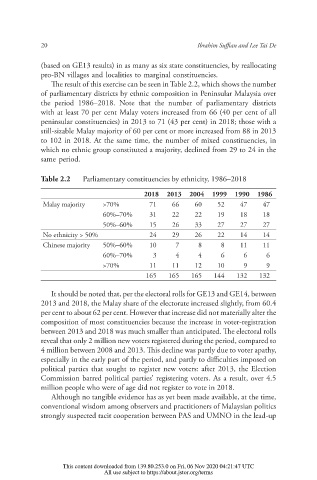
                      e result of this exercise can be seen in Table 2.2, which shows the number
                  of parliamentary districts by ethnic composition in Peninsular Malaysia over
                  the period 1986–2018. Note that the number of parliamentary districts
                  with at least 70 per cent Malay voters increased from 66 (40 per cent of all
                  peninsular constituencies) in 2013 to 71 (43 per cent) in 2018; those with a
                  still-sizable Malay majority of 60 per cent or more increased from 88 in 2013
                  to 102 in 2018. At the same time, the number of mixed constituencies, in
                  which no ethnic group constituted a majority, declined from 29 to 24 in the
                  same period.

                  Table 2.2   Parliamentary constituencies by ethnicity, 1986–2018

                                              2018  2013  2004  1999   1990  1986
                   Malay majority  >70%         71    66    60    52    47    47
                                   60%–70%      31    22    22    19    18    18
                                   50%–60%      15    26    33    27    27    27
                   No ethnicity > 50%           24    29    26    22    14    14
                   Chinese majority  50%–60%    10     7     8     8    11    11
                                   60%–70%       3     4     4     6     6      6
                                   >70%         11    11    12    10     9      9
                                               165   165   165   144   132   132


                     It should be noted that, per the electoral rolls for GE13 and GE14, between
                  2013 and 2018, the Malay share of the electorate increased slightly, from 60.4
                  per cent to about 62 per cent. However that increase did not materially alter the
                  composition of most constituencies because the increase in voter-registration
                  between 2013 and 2018 was much smaller than anticipated.  e electoral rolls
                  reveal that only 2 million new voters registered during the period, compared to
                  4 million between 2008 and 2013.  is decline was partly due to voter apathy,
                  especially in the early part of the period, and partly to di culties imposed on
                  political parties that sought to register new voters: after 2013, the Election
                  Commission barred political parties’ registering voters. As a result, over 4.5
                  million people who were of age did not register to vote in 2018.
                     Although no tangible evidence has as yet been made available, at the time,
                  conventional wisdom among observers and practitioners of Malaysian politics
                  strongly suspected tacit cooperation between PAS and UMNO in the lead-up


                        This content downloaded from 139.80.253.0 on Fri, 06 Nov 2020 04:21:47 UTC
                                   All use subject to https://about.jstor.org/terms

